Ratan Tata’s body will be placed at the National Centre for Performing Arts (NCPA) in Mumbai’s Nariman Point today from 10 a.m. to 4 p.m., allowing people to pay their final respects.
Source: NDTV
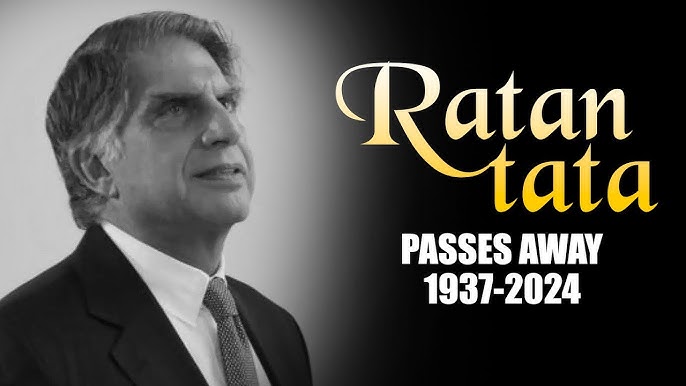
Mumbai: Industry titan Ratan Tata, who passed away at the age of 86 in a Mumbai hospital on Wednesday, will be cremated with full state honours. Maharashtra Chief Minister Eknath Shinde has declared a day of mourning on Thursday to pay tribute to the legendary industrialist and philanthropist.
As a mark of respect, the national flag will be flown at half-mast across all government offices in Maharashtra, and several events scheduled for Thursday have been cancelled.
Ratan Tata’s body will be kept at the National Centre for Performing Arts (NCPA) in Mumbai’s Nariman Point from 10 a.m. to 4 p.m. today, allowing people to pay their final respects. The cremation ceremony will be held later in the day at Worli. Home Minister Amit Shah is expected to attend the funeral, as Prime Minister Narendra Modi has left for Laos to participate in the ASEAN-India and East Asia summits.
The passing of Mr. Ratan Tata signifies the end of an era in Indian business. A visionary leader, he transformed the nation’s industrial landscape and propelled his family-owned conglomerate into a global powerhouse.
Despite overseeing more than 30 companies operating in over 100 countries across six continents, Mr. Tata led an unassuming life. His influence and success were immense, yet he never appeared on lists of billionaires. He remained a figure of quiet integrity and humility, admired for his principles and dedication to the greater good.
Born on December 28, 1937, in Mumbai, Ratan Tata came from one of India’s most prominent business families. He was the great-grandson of Jamsetji Tata, who founded the Tata Group in 1868. What started as a small trading firm eventually became a massive business empire with ventures in steel, salt, automobiles, software, and even airlines.
Ratan Tata’s early years were marked by both privilege and challenges. Raised by his grandmother, Lady Navajbai Tata, after his parents separated when he was young, he attended the Cathedral and John Connon School in Mumbai. Later, he moved to the United States, where he earned a degree in Architecture from Cornell University in 1962.
He also attended Harvard Business School’s Advanced Management Program but put his architecture dreams aside to join the family business in the early 1960s. His first role was at Tata Steel’s Jamshedpur plant, where he worked on the shop floor—a hands-on approach that would define his leadership style.
In 1971, Ratan Tata was appointed director-in-charge of Nelco, a struggling Tata Group company. Despite his efforts, the company couldn’t turn around due to the challenging economic conditions of the 1970s.
In 1991, Ratan Tata took over as chairman of the Tata Group from his uncle, JRD Tata, who had led the conglomerate for more than 50 years. Many doubted whether he could fill his uncle’s shoes, but he soon proved them wrong.
That same year, India opened its economy, shifting away from protectionist policies. Ratan Tata took advantage of this opportunity to steer the Tata Group into a new era of global expansion, innovation, and modern management.
In 2000, Ratan Tata made headlines with the $431.3 million purchase of the British tea company Tetley Tea, marking the Tata Group’s first major international acquisition. This was followed by the acquisition of Daewoo Motors’ truck manufacturing business in South Korea in 2004 for $102 million. In 2007, Tata Steel acquired the Anglo-Dutch company Corus Group for $11.3 billion, making Tata Steel the fifth-largest steelmaker in the world.
Another milestone was in 2008, when Tata Motors bought the iconic British car brands Jaguar and Land Rover (JLR) from Ford for $2.3 billion. Though JLR was struggling at the time, it became one of Tata Group’s most profitable divisions under his leadership.
One of his most personal projects was the Tata Nano, a small, affordable car designed to bring vehicle ownership within reach for millions of Indians. Launched in 2008 and priced at just ₹1 lakh, it became known as “the people’s car” and was the world’s cheapest car.
While Ratan Tata was a business giant, he was equally known for his philanthropy. Through the Tata Trusts, established by his great-grandfather, a large part of Tata Sons’ wealth is used for social causes. Even after retiring as chairman of Tata Sons in 2012, Ratan Tata continued to support young entrepreneurs and invested in over 30 start-ups, including Ola Electric, Paytm, and Lenskart, through his investment firm RNT Capital Advisors.
Ratan Tata’s passing has led to an outpouring of grief and tributes across India. Prime Minister Narendra Modi called him a visionary business leader and a compassionate soul, while business leaders like Gautam Adani, Anand Mahindra, and Sundar Pichai also shared their condolences.
His body will be kept at the National Centre for Performing Arts (NCPA) in Mumbai today from 10 a.m. to 4 p.m., where people can pay their respects, and the cremation will be held later in the day at Worli.
Follow us for more