In a remarkable achievement for Indian higher education, IIT-Kharagpur, Jadavpur University (JU), and Calcutta University (CU) have earned coveted spots in the QS World University Rankings for Asia 2025, ranking among the top 250 institutions across the continent. This year’s ranking highlights the exceptional performance and global reputation of these institutes, each demonstrating excellence across various parameters despite unique challenges. IIT-Kharagpur secured the 60th position overall in Asia and 4th in Southern Asia, while CU and JU placed at 179th and 211th, respectively, continuing to represent the strength of Indian academia in international circles.
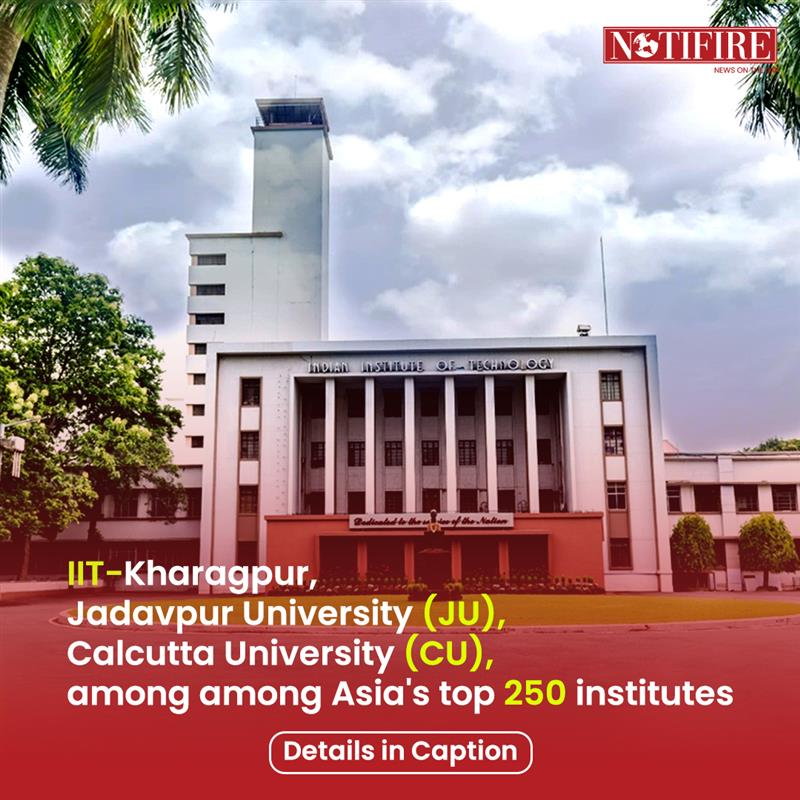
IIT-Kharagpur: A Leader in Innovation and Research
IIT-Kharagpur has consistently set benchmarks in research, academic excellence, and international collaboration, securing the 60th position in Asia. This ranking marks an improvement from its previous 59th position in 2024, underscoring the institute’s dedication to advancement. Notably, IIT-Kharagpur scored exceptionally high in areas like academic reputation, research output, and employer reputation.
The institution scored an impressive 94.8 out of 100 in the ‘papers per faculty’ metric, reflecting its focus on research quality and output per academician. In addition, it achieved a score of 93.5 in the ‘international research network’ category, a testament to its collaborative endeavors with universities and research centers across the globe. IIT-Kharagpur also performed well in ‘academic reputation’ and ‘employer reputation,’ with scores of 80.3 and 89.5, respectively, reflecting the high regard in which it is held by both academic peers and industry employers.
According to Director V.K. Tewari, “IIT-Kharagpur has upheld its determination to impart global standards of educational excellence in India.” The institute’s commitment to cutting-edge research, innovation, and international collaboration positions it as a powerhouse in Indian and global academia. IIT-Kharagpur’s success reflects the rigorous standards maintained by the IIT system and its focus on creating a fertile ground for technological advancement and scientific inquiry.
Calcutta University: Rising Through Tradition and Research Excellence
Calcutta University, one of India’s oldest universities, demonstrated substantial growth, climbing from the 187th position in 2024 to 179th in 2025, reflecting a consistent rise in its academic and research metrics. With a history of producing eminent scholars, CU’s continued focus on traditional and emerging fields has helped it secure a prominent place in the rankings.
The university achieved an overall score of 42.4, showing improvements across various indicators. CU performed well in areas such as academic reputation, international research network, faculty-student ratio, and research output, particularly in the ‘papers per faculty’ and ‘citations per paper’ categories. Its emphasis on research and global partnerships has been pivotal in its ascent in the QS rankings. This rise aligns with the university’s mission to foster intellectual development and innovation in a globalized academic environment.
CU has consistently built on its strengths in arts, sciences, and humanities while expanding its scope to interdisciplinary and applied research. The institution’s rise in the QS World University Rankings serves as an acknowledgment of its steady improvement in research productivity, academic reputation, and employer recognition. CU’s efforts to enhance international research collaborations and foster innovation reflect its determination to maintain relevance in a rapidly evolving academic landscape.
Jadavpur University: Excellence Despite Constraints
Ranked 211th in Asia, Jadavpur University demonstrated a commendable improvement from its 228th position last year. JU has been lauded for its strengths in research and academic reputation, particularly excelling in categories like ‘citations per paper’ and ‘international research network.’ This consistent performance under challenging conditions highlights the resilience and dedication of its faculty and students.
With an overall score of 37.1, JU has shown significant improvements in academic reputation, citations per paper, papers per faculty, and its international research network. Pro-Vice Chancellor Amitava Datta acknowledged the university’s challenges, noting that the faculty-student ratio has suffered due to a hiring freeze over the past two years. Despite these setbacks, JU has continued to produce impactful research, attracting recognition in India and abroad.
According to Datta, “The university has suffered in the faculty-student ratio parameter because teacher recruitment has not started for two years.” Yet, JU’s robust performance across other metrics is a testament to the institution’s dedication to research and academic excellence, even under financial and administrative constraints. The university’s success demonstrates the value of perseverance and hard work in creating a conducive environment for learning and discovery.
The Impact of QS Rankings on Indian Higher Education
The QS World University Rankings, released by British company Quacquarelli Symonds, are among the most respected assessments of global higher education institutions. The rankings evaluate universities across ten parameters, including academic reputation, employer reputation, faculty-student ratio, international research network, research citations, research output per faculty, percentage of staff with Ph.D. degrees, and student exchange opportunities. Each of these metrics offers insights into the overall academic standing, research quality, and global engagement of institutions.
Indian institutions, particularly those like IIT-Kharagpur, CU, and JU, benefit significantly from recognition in these rankings. For these universities, a place in the QS World University Rankings enhances their visibility and appeal, attracting talent from within India and globally. It also underscores the potential of Indian higher education institutions to compete on an international level, further motivating universities to invest in research, academic innovation, and global partnerships.
Key Challenges and Opportunities for Indian Universities
The progress made by IIT-Kharagpur, CU, and JU is commendable, but Indian universities continue to face challenges that impact their global rankings. Funding constraints, faculty shortages, and administrative hurdles are common issues that affect the performance of public universities, limiting their capacity to expand research, increase faculty-student ratios, and improve infrastructure.
Despite these challenges, Indian institutions are increasingly adopting global best practices in academia and research, enabling them to compete with universities worldwide. By focusing on building strong international research networks, improving academic reputation, and strengthening employer reputation, Indian universities can enhance their performance in rankings and become more attractive to both domestic and international students.
The Road Ahead
The accomplishments of IIT-Kharagpur, CU, and JU in the QS World University Rankings reflect their determination to provide high-quality education and foster research excellence. While each institution has its unique strengths, all three share a commitment to pushing the boundaries of knowledge and contributing to global academic advancement.
For India, these achievements mark important milestones in its journey toward establishing itself as a hub of global education. The success of IIT-Kharagpur, CU, and JU demonstrates that Indian institutions can meet the demands of an increasingly competitive academic landscape. As Indian universities continue to climb in global rankings, their success will inspire further improvements in the country’s higher education system, making India an influential player on the global academic stage.
In conclusion, the QS World University Rankings for Asia 2025 are not only a celebration of the achievements of IIT-Kharagpur, CU, and JU but also a call to action for Indian institutions to continue striving for excellence. The journey of these universities highlights the potential for Indian academia to make a lasting impact on the world stage through innovation, collaboration, and resilience.
Follow us for more