AI Agents Are Now Joining US Army Cyber Teams
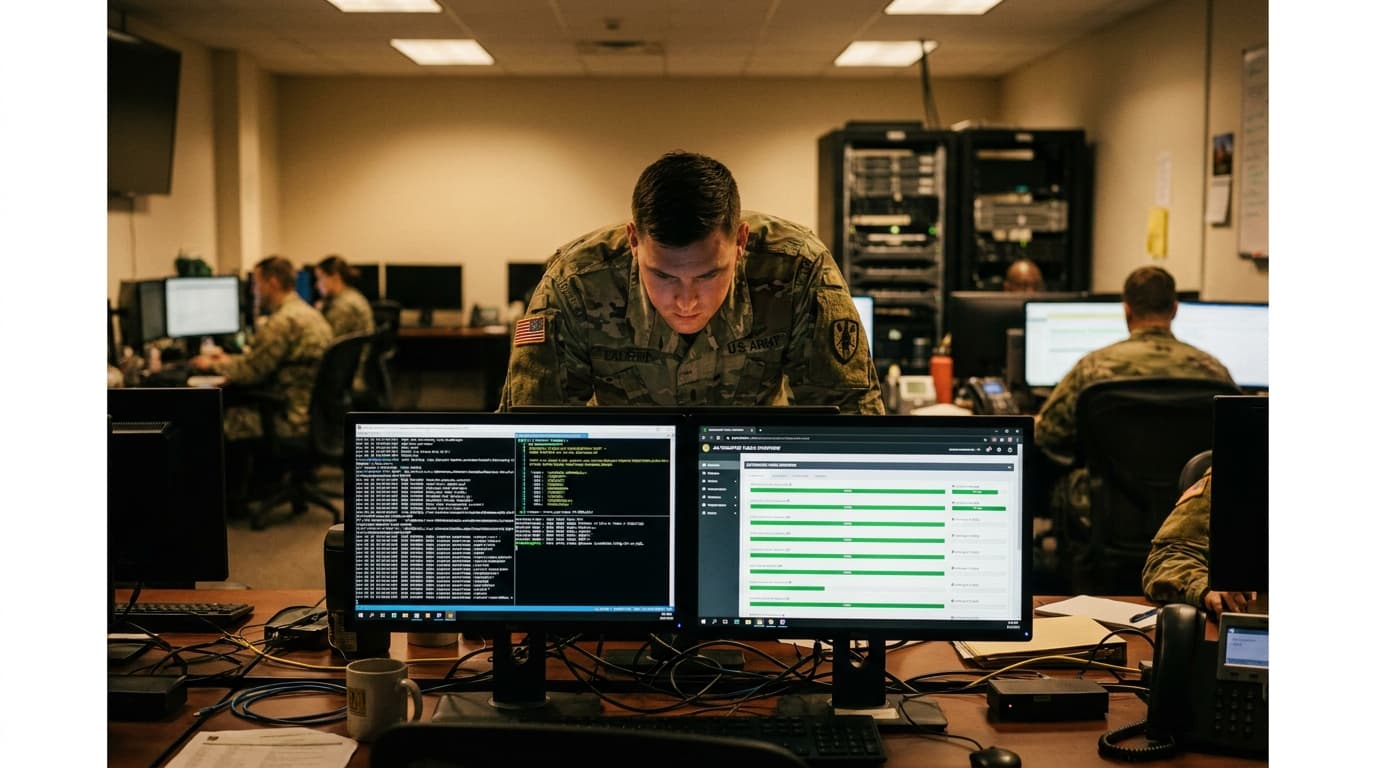
TL;DR: The US Army is now training AI agents for specific cybersecurity jobs, working alongside human soldiers. This marks a major step in human-AI collaboration for critical operations, though human commanders retain final authority over all high-risk decisions.
Key facts
- Category
- AI
- Impact
- High
- Published
- Source
- TechRadar
Full summary
The US Army is now training AI agents for specialized cyber roles, integrating them into operational units under human command and supervision.
The US Army is integrating specialized artificial intelligence agents into its cyber operations units, according to a report from TechRadar. These AI agents are not general-purpose tools but are being trained for specific, defined work roles, much like their human counterparts. They operate alongside soldiers, performing specialized tasks within cybersecurity and development teams. Crucially, this deployment model keeps humans firmly in control. Human commanders retain the ultimate authority, deciding which operational risks the AI agents are permitted to handle and supervising their activities. This initiative represents one of the most significant real-world applications of autonomous AI agents within a major government organization, moving the concept from theoretical research into practical, mission-critical use.
The Army's approach treats these AI agents as functional team members rather than just software. The training process for these agents reportedly uses standards similar to those for human personnel, suggesting a structured curriculum designed to build and validate specific skills for their assigned cyber roles. This implies a system of performance metrics, continuous learning, and operational readiness checks. In practice, an AI agent might be tasked with continuously monitoring network traffic for anomalies, identifying potential threats, or even writing and testing code for specific applications. However, the model is built on a foundation of human supervision. The AI performs its assigned function, but a human operator or commander is always in the loop to review its findings, validate its proposed actions, and provide the final authorization before any high-stakes decision is executed. This ensures accountability and control, preventing the AI from operating with unchecked autonomy in sensitive environments.
For technology leaders, developers, and security professionals, this development is a powerful signal. When a historically cautious and risk-averse institution like the US Army begins deploying AI agents in critical roles, it validates the technology's maturity and reliability. This is no longer a futuristic concept; it is a present-day reality. For security teams, it provides a blueprint for how AI can be used to augment human capabilities, handling the high-volume, repetitive tasks of threat detection and analysis. This frees up human experts to focus on more complex, strategic challenges like threat hunting and incident response strategy. For CTOs and engineering leads, it introduces a new paradigm for team composition. The future of technical teams will likely be a hybrid of human and AI talent, requiring new management styles, workflows, and tools to orchestrate their collaboration effectively.
The military often serves as a proving ground for technologies that later become mainstream in the enterprise. The Army's adoption of AI agents for specialized work roles is a strong indicator of a coming shift in the broader technology industry. Businesses should anticipate the rise of enterprise-grade AI agents designed for specific functions in areas like SecOps, DevOps, quality assurance, and IT support. The key takeaway for organizations is to begin strategic planning for this hybrid workforce. This involves identifying tasks and roles within your own teams that are suitable for AI augmentation. Leaders should start thinking about the necessary governance frameworks, ethical guidelines, and operational protocols required to manage AI teammates. The focus should be on building systems of control and supervision, ensuring that AI agents enhance human productivity and decision-making without introducing unacceptable risks.
Looking ahead, the Army's initiative will likely accelerate private sector development of platforms for building, training, and managing specialized AI agents. We can expect to see a new class of enterprise software emerge focused on the lifecycle of these "digital workers." Key challenges that will come into focus include the security of the agents themselves—how to prevent them from being compromised—and the question of accountability when an AI system makes a mistake. The frameworks and doctrines the military develops for command and control of AI could offer valuable lessons for corporations navigating these same issues. The next major milestone to watch for will be how these roles expand and how the human-AI team collaboration model evolves based on real-world operational feedback.
Related on Notifire
Related stories
Primary source: TechRadar