This Startup Is Building Data Centers With Macs
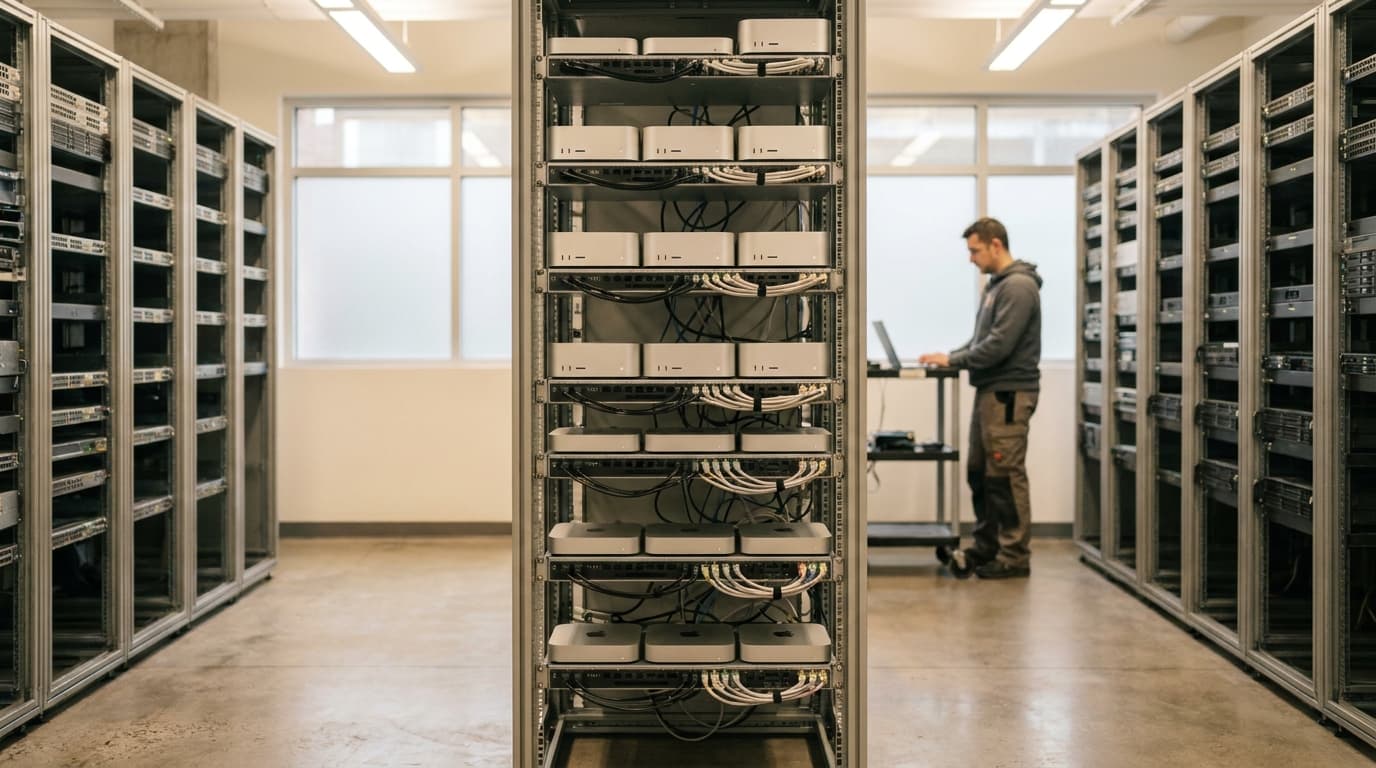
TL;DR: A startup founded by an OpenAI alumnus raised $45 million to build data centers using Apple computers. The goal is to give AI agents a native macOS environment to learn how to perform complex tasks on desktop software.
Key facts
- Category
- AI
- Impact
- High
- Published
- Source
- TechRadar
Full summary
A startup raised $45M to build Mac-based data centers, giving AI agents a native desktop environment for training and operation.
A startup founded by a former OpenAI engineer, Mount Thor, has secured $45 million in funding across its seed and Series A rounds to build a new kind of AI infrastructure. As reported by TechRadar, the company is creating data centers filled with racks of Apple computers. This significant investment highlights a growing demand for specialized environments to train and operate AI agents. Unlike traditional cloud servers that run Linux, Mount Thor provides access to thousands of machines running native macOS. The company has already deployed its first data center, signaling a serious effort to solve a key bottleneck in the development of autonomous AI systems that can interact with software the way a human does.
Mount Thor’s approach addresses a fundamental challenge for AI agents: they need to learn in the same environment where they will eventually work. Most modern software, from creative suites to business applications, relies on a graphical user interface (GUI). AI agents designed to automate tasks within these programs must be able to see and interact with on-screen elements like buttons, menus, and windows. Traditional cloud infrastructure, which is typically command-line-based, cannot replicate this experience. By racking thousands of Mac Minis, Mount Thor provides developers with scalable, remote access to real desktop environments. This allows an AI agent to control a mouse and keyboard on a genuine macOS system, providing a high-fidelity training ground that virtual machines or simulators often struggle to match.
The emergence of specialized hardware providers like Mount Thor is a direct response to the evolution of AI from text-based models to action-oriented agents. The industry is rapidly moving toward creating AI systems that can complete complex, multi-step tasks on a user's behalf, such as booking travel, managing spreadsheets, or editing photos. This requires the AI to understand and navigate the user interfaces of various applications. Until now, a major obstacle has been the lack of infrastructure to train and test these agents at scale. Mount Thor’s Mac data centers represent a physical, brute-force solution to this software problem, suggesting the market for AI agent infrastructure is maturing beyond experimental setups and into a distinct service category.
For developers, CTOs, and founders, this development validates the growing importance of the agent's operating environment. Building effective AI agents is not just about the model, but also about the infrastructure it runs on. While most companies cannot build their own Mac data centers, the availability of a service like Mount Thor opens up new possibilities for building and deploying sophisticated automation. This trend is worth watching closely. We can expect to see competitors emerge, potentially offering similar infrastructure for Windows environments. The success of this model may also push major cloud providers like AWS and Google to offer native desktop operating systems as a scalable service, fundamentally changing how developers build the next generation of AI-powered tools.
Why it matters
This signals a shift from abstract, API-based AI training to training agents in real-world graphical user interfaces. It creates a new infrastructure category for developing agents that can operate consumer and enterprise software, directly impacting how developers build and test them.
Business impact
This new infrastructure model could unlock AI agents capable of automating complex desktop workflows, creating new markets for AI-driven services. Companies that rely on macOS software may soon be able to deploy agents to handle this work, boosting productivity and reducing manual labor costs.
Tags
Related on Notifire
Related stories
Primary source: TechRadar