AI Is Now Generating Its Own Drug Data
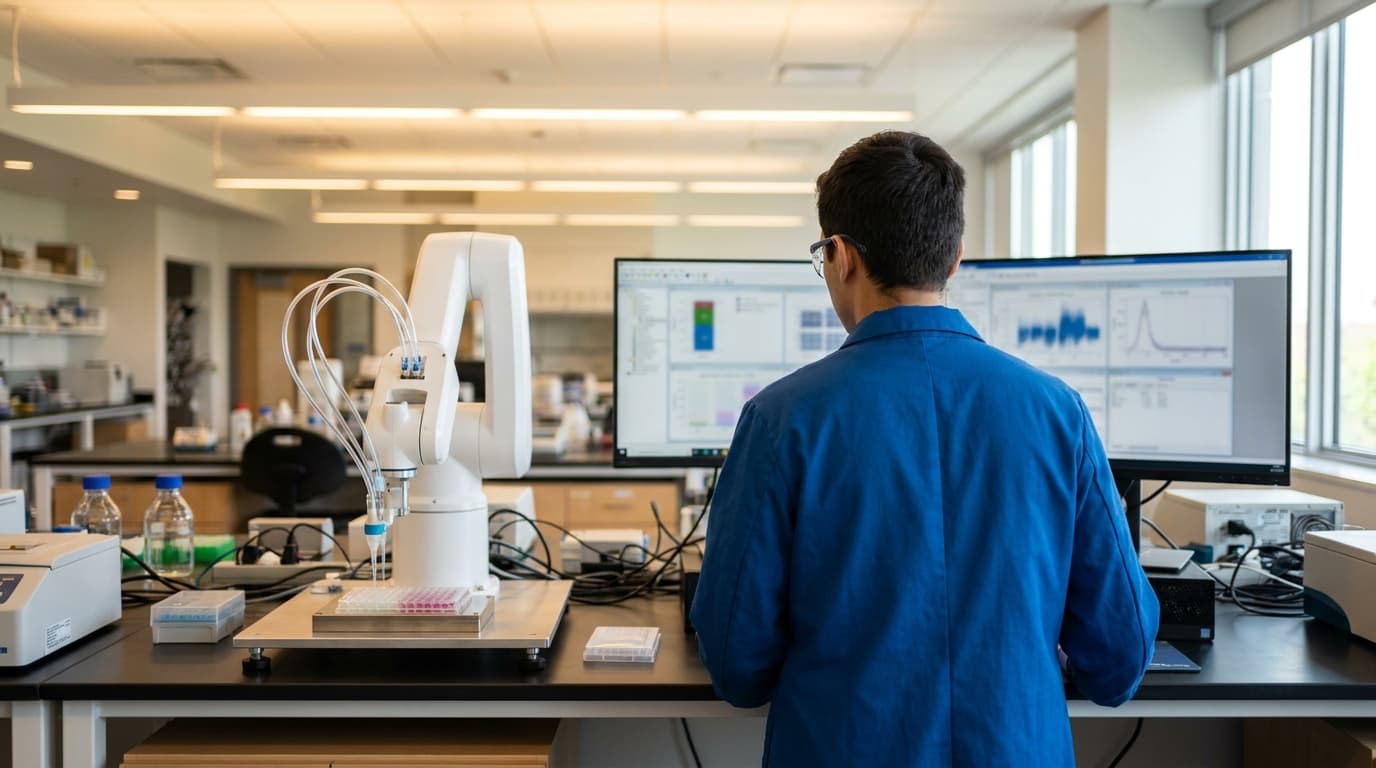
TL;DR: AI systems are now running their own lab experiments to generate new data, creating a powerful feedback loop. This self-improving cycle promises to slash the decade-long, billion-dollar process of bringing new drugs to market.
Key facts
- Category
- AI
- Impact
- High
- Published
- Source
- MIT Technology Review
Full summary
AI is no longer just analyzing data for drug discovery—it's now generating its own, creating a powerful self-improving feedback loop.
According to a report from MIT Technology Review, a fundamental shift is underway in how artificial intelligence is applied to drug discovery. For decades, the pharmaceutical industry has been plagued by what is known as Eroom’s Law—the opposite of Moore's Law—where the cost of developing a new drug has consistently doubled every nine years, now reaching into the billions. To combat this, leading firms are moving beyond using AI to simply analyze existing datasets. They are now building closed-loop systems where AI not only designs experiments but also uses robotic labs to execute them, generating a constant stream of high-quality, proprietary data that is then fed back into the model to improve it. This creates a powerful, self-reinforcing cycle that promises to break the costly trend of pharmaceutical R&D.
The core innovation is the transition from passive data analysis to active learning. Traditional machine learning models in this field were trained on vast but often inconsistent historical data from past experiments. The new "data loop" approach is fundamentally different. An AI model first generates hypotheses about which molecules might be effective drug candidates. Instead of waiting for human scientists to test these, the system sends instructions to an automated, robotic laboratory. This lab synthesizes and tests the proposed compounds, capturing the results in real-time. This new, clean data is immediately used to retrain and refine the AI model, which then designs the next, more intelligent round of experiments. This iterative process creates a flywheel, where each cycle produces better data, which in turn creates a smarter model capable of making more accurate predictions.
For developers, CTOs, and founders, this model offers a powerful template that extends far beyond the pharmaceutical industry. The key insight is the strategic value of building systems that generate their own exclusive training data. In any field limited by the cost and time of physical experimentation—such as materials science, battery chemistry, or agricultural technology—this closed-loop approach can create a formidable competitive advantage. It transforms AI from a tool that consumes public or licensed data into a core asset that produces a private, ever-improving data moat. Companies that master this flywheel can accelerate their R&D cycles at a rate their competitors simply cannot match, fundamentally changing the innovation landscape and creating winner-take-all dynamics.
The business implications for the biotech and pharmaceutical sectors are immense. By drastically reducing the time and capital required to move from a hypothesis to a viable drug candidate, this technology could upend the industry's traditional risk and investment models. The decade-plus timeline and billion-dollar price tag for a new drug could be significantly compressed, allowing for more shots on goal and the pursuit of treatments for rarer diseases. This shift also creates new market opportunities for technology companies specializing in lab automation, robotics, and specialized AI platforms. We can expect to see a surge in partnerships between established pharmaceutical giants, who possess deep domain knowledge and regulatory experience, and agile tech startups that are building these automated discovery engines.
Looking ahead, the primary challenge will be scaling these complex, capital-intensive systems and integrating them into the highly regulated pharmaceutical pipeline. Proving the safety and efficacy of an AI-discovered compound to regulators like the FDA will be the ultimate test. The next frontier involves expanding the AI's role beyond simple molecule discovery to predicting how these compounds will behave in complex human biological systems and even helping to design more efficient clinical trials. The companies that successfully navigate the technical, regulatory, and operational hurdles of building these AI-driven labs will not only discover new medicines but will also define the future of scientific research itself.
Related on Notifire
Related stories
Primary source: MIT Technology Review