Anthropic's Claude AI Builds Its Own Agent Managers
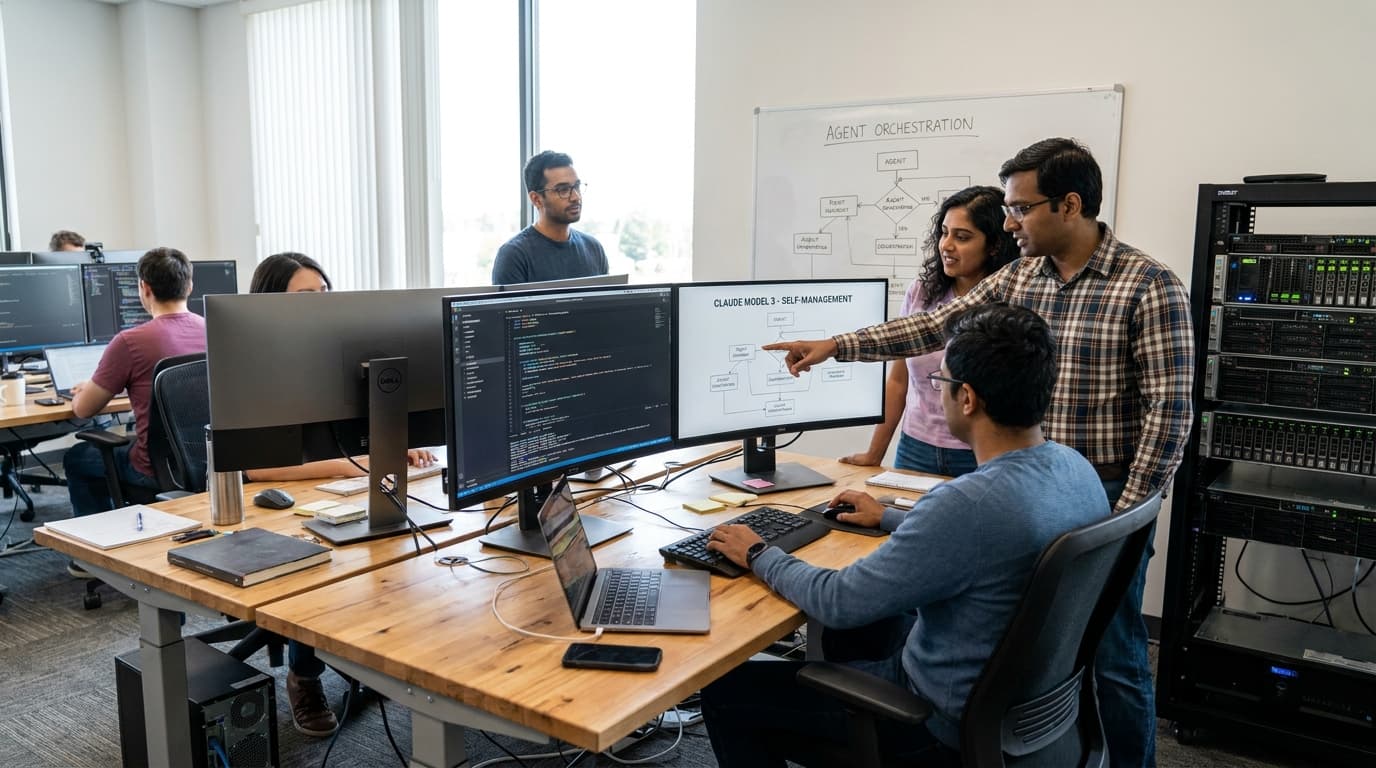
TL;DR: Anthropic's Claude AI can now generate its own custom "execution harnesses." This system allows it to coordinate teams of specialized AI agents to complete complex, multi-step tasks more effectively for developers.
Key facts
- Category
- AI
- Impact
- High
- Published
- Source
- InfoQ
Full summary
Anthropic's Claude AI now generates its own systems to coordinate teams of AI agents, enabling it to handle more complex, multi-step tasks.
Anthropic has shared details about a powerful feature in its Claude AI called Dynamic Workflows. The system allows Claude to solve complex problems by creating what it calls "execution harnesses." In simple terms, the AI generates a custom management plan on the fly to coordinate a team of specialized AI agents. For a given task, Claude can assemble a virtual team—for example, one agent to write code, another to test it, and a third to write documentation. The self-generated harness acts as the project manager, assigning tasks and ensuring the agents work together effectively to reach the goal. This process is dynamic, with a unique plan created for each problem.
This development is significant for developers and CTOs because it marks a step forward in AI orchestration. It moves beyond single-prompt interactions toward handing off entire multi-step workflows to an AI system. This allows developers to treat the AI less like a simple assistant and more like an autonomous project manager. For businesses, this technology enables more sophisticated automation. It reduces the need for engineers to write complex scripts to chain AI calls together. By letting the AI build its own management layer, companies can accelerate development, automate internal processes, and empower smaller teams to tackle bigger projects.
Anthropic's work is part of a wider industry push toward more autonomous AI agents. While many companies are building agents that can use tools, the ability for an AI to dynamically generate a management structure for other agents is a key innovation. This "meta-level" capability, where one AI orchestrates others, is crucial for tackling real-world business challenges. As this technology matures, we can expect to see AI systems that can independently manage entire projects, from planning to execution, with less direct human supervision at each step.
Why it matters
This marks a shift from single-prompt AIs to autonomous systems that can plan and execute complex, multi-step projects. It allows developers to offload entire workflows, treating AI less like a tool and more like a project manager.
Business impact
Businesses can leverage this to build more powerful automation for software development, data analysis, and other complex processes. It could significantly accelerate project timelines and enable smaller teams to tackle larger-scale tasks with less manual oversight.
Related on Notifire
Related stories
Primary source: InfoQ