Hollywood Mogul Says AI Is Finally Ready for Movies
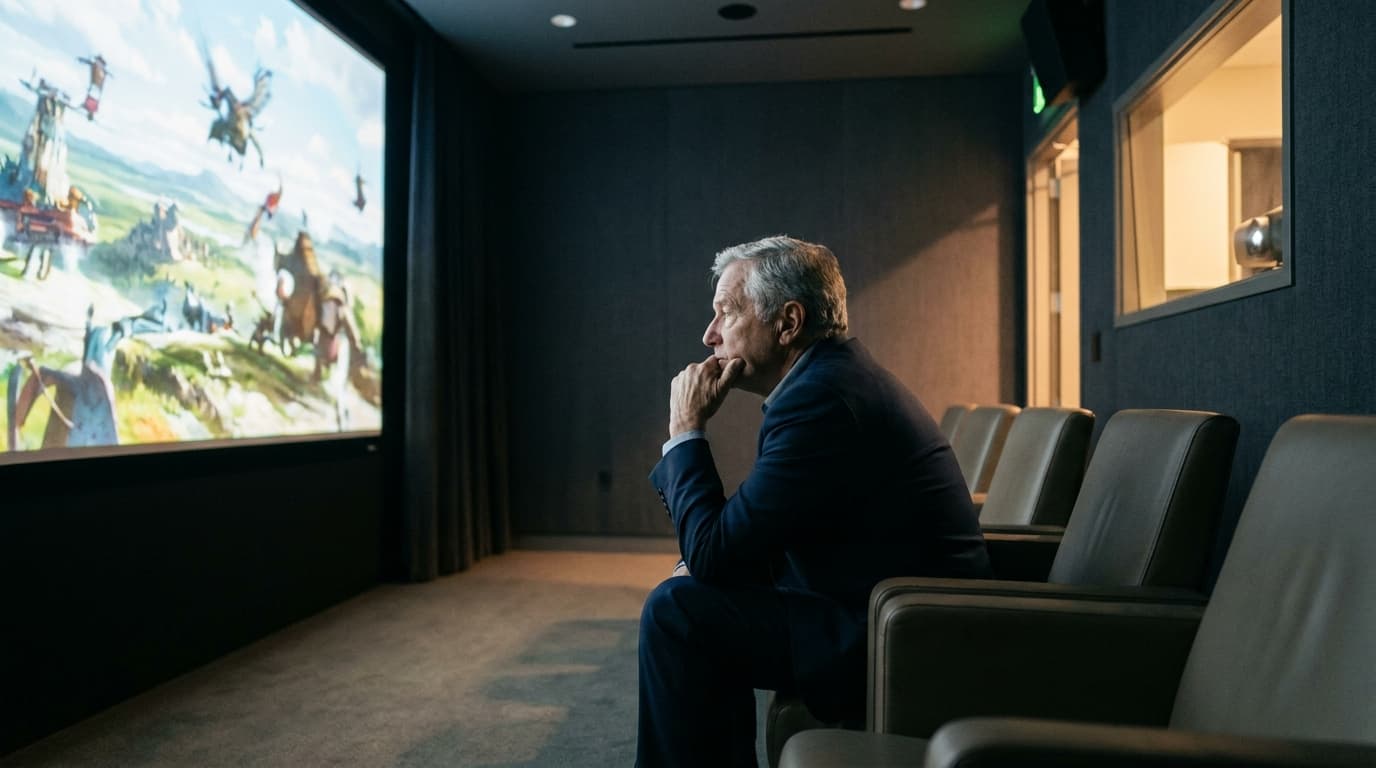
TL;DR: Dreamworks co-founder Jeffrey Katzenberg is launching an AI-focused film studio, saying AI's output has rapidly improved from 'slop' to movie-ready quality. This signals a major commercial bet on generative AI for high-end creative production.
Key facts
- Category
- AI
- Impact
- High
- Published
- Source
- TechRadar
Full summary
Dreamworks co-founder Jeffrey Katzenberg is launching an AI film studio, saying the technology's output is now good enough for feature films.
A major shift is underway in Hollywood, signaled by one of its most influential figures. Jeffrey Katzenberg, the veteran executive who co-founded Dreamworks, has announced the launch of a new AI-focused studio dedicated to creating feature films and television. According to reporting from TechRadar, which cited an interview with The Wrap, this marks a significant change of heart for Katzenberg. He admitted that until very recently, he considered AI-generated content to be “slop.” However, he claims that a dramatic leap in quality over the last few months has convinced him that the technology is now ready for professional, high-stakes creative production. This move by a seasoned industry leader represents one of the most substantial commercial endorsements of generative AI for mainstream entertainment to date, moving it from a theoretical tool to a core business strategy.
The rapid pivot from “slop” to studio-worthy in just a few months points to the exponential progress in generative video models. Early iterations of text-to-video AI produced short, often incoherent clips with poor object permanence and inconsistent physics. The recent breakthrough, which likely spurred Katzenberg’s investment, is the emergence of models capable of generating longer, more cohesive scenes. These newer systems demonstrate a much-improved understanding of narrative continuity, character consistency, and stylistic control. While still far from perfect, they can now produce footage that is visually compelling and thematically stable enough to serve as a foundation for professional storytelling. This leap is not just about resolution or frame rate; it is a fundamental improvement in the models' ability to interpret complex prompts and maintain a coherent world, a prerequisite for any form of long-form narrative media.
Katzenberg’s venture arrives at a critical moment for the entertainment industry. His top-down embrace of AI stands in stark contrast to the bottom-up anxieties expressed by writers and actors during the 2023 Hollywood strikes, where protections against AI were a central demand. This development suggests that despite ongoing labor concerns and audience skepticism about AI-generated art, the perceived economic advantages are becoming too significant for industry leadership to ignore. The potential to drastically reduce production costs, accelerate animation and VFX workflows, and rapidly prototype creative concepts presents a powerful business case. Katzenberg's AI film studio is a clear signal that major players are willing to invest heavily in this new technological paradigm, potentially creating a new divide between traditional production houses and more agile, tech-forward studios.
For founders, developers, and CTOs, this is a major validation of the commercial potential for generative AI beyond chatbots and image creation. Katzenberg's move effectively lights up a new, high-value market for specialized AI tools and the underlying infrastructure. The demand will grow for everything from fine-tuned models trained for specific animation styles to sophisticated MLOps platforms designed to manage complex, multi-modal creative pipelines. The next phase to watch will be the competitive response from other major studios, the race to acquire talent that can bridge the gap between creative direction and technical implementation, and the quality of the first feature-length projects to emerge from this new model of filmmaking. This venture is a real-world stress test for AI's creative capabilities, and its success or failure will have significant ripple effects across the tech and media industries.
Why it matters
For developers and CTOs, this move validates generative AI as a viable technology for high-value commercial production, not just experiments. It signals a coming surge in demand for specialized AI models, creative workflow tools, and the infrastructure required to support large-scale media generation.
Business impact
Katzenberg's venture creates a new, high-profile market for AI startups and established tech firms. This move will likely accelerate investment in generative media technology, forcing traditional production houses to develop their own AI strategies or risk falling behind a more efficient, technology-driven competitor.
Tags
Related on Notifire
Related stories
Primary source: TechRadar