Microsoft AI Checks Its Own Medical Scans
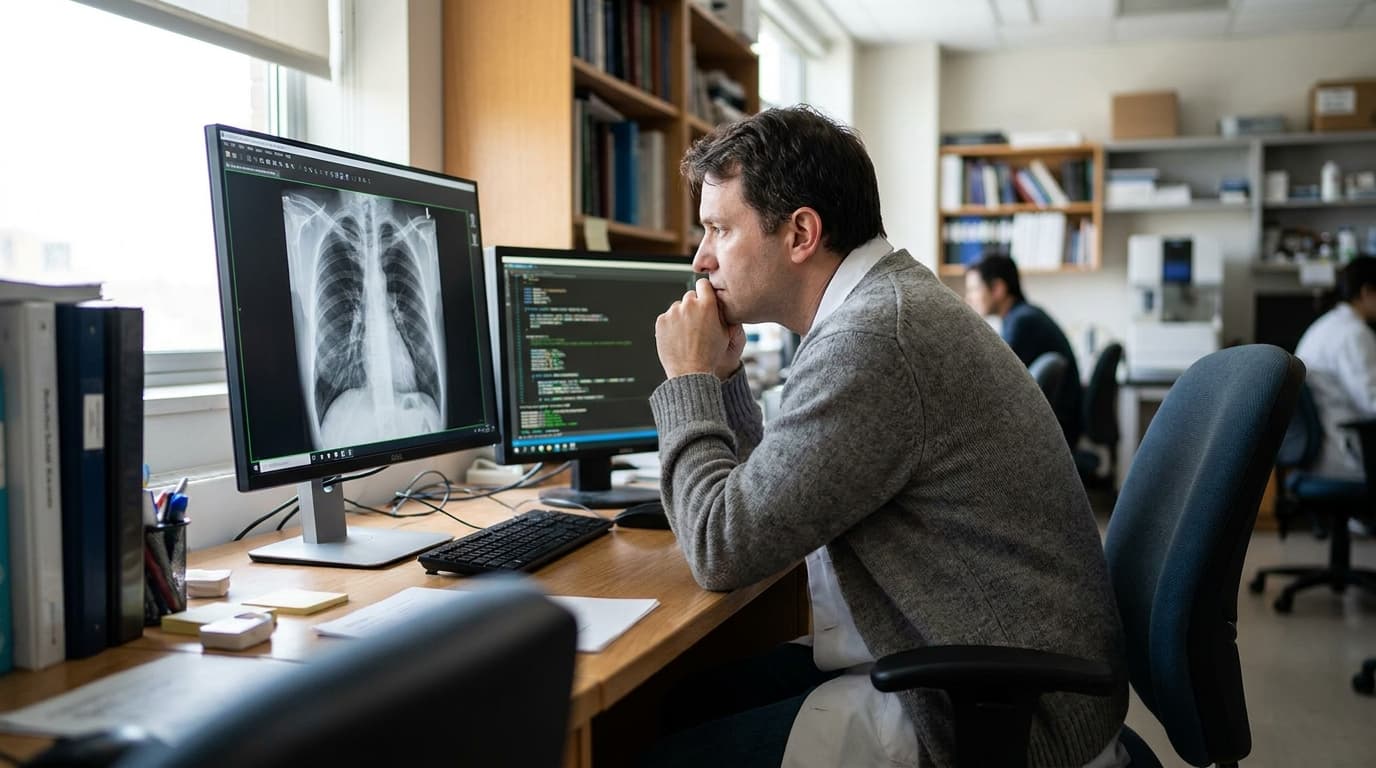
TL;DR: Microsoft has a new research AI for radiology that can use digital tools to measure its own findings in scans. This approach aims to make AI-generated medical reports more accurate, verifiable, and clinically useful for doctors.
Key facts
- Category
- AI
- Impact
- High
- Published
- Source
- Microsoft Research
Full summary
Microsoft's new radiology AI uses digital tools to measure its own findings, aiming for more accurate and verifiable medical scan analysis.
Microsoft Research has introduced a new vision-language model (VLM) named CARE-X, designed to interpret medical images like X-rays and CT scans. This model aims to generate radiology reports that are not only descriptive but also clinically useful and verifiable. In a detailed research note, Microsoft emphasized that CARE-X is currently a research project and not a commercial product or medical device. Its purpose is to explore new techniques for making AI in high-stakes fields more reliable. Unlike general-purpose image models, CARE-X is specifically trained on medical imaging data and terminology to understand the complex nuances of radiological analysis, bridging the gap between what an AI sees in a scan and how a human doctor would describe it.
What sets CARE-X apart is its ability to use tools to check its own work, a technique Microsoft calls tool-augmented measurement. Instead of just identifying a potential issue in a scan, the model can activate a digital measuring tool to quantify its size and location, similar to how a human radiologist would. This makes its findings objective and easy to verify. The model is also trained using reward-aligned learning, where it receives feedback that prioritizes clinical accuracy and relevance over simply matching text from a training dataset. This helps align the AI's outputs with the practical needs of clinicians. Furthermore, it uses a method called auxiliary supervision, where it learns from additional, simpler labels—like identifying specific organs—to build a more robust foundational understanding of medical anatomy before tackling complex diagnostic tasks.
For developers and CTOs, CARE-X demonstrates a critical shift in building specialized AI systems. The move away from opaque, "black box" models toward verifiable, tool-using agents is essential for gaining trust in critical domains like healthcare, finance, and engineering. When an AI's output can be audited and its measurements independently confirmed, it becomes a far more reliable partner in a professional workflow. This approach provides a blueprint for creating AI that doesn't just provide an answer but also shows its work, allowing human experts to quickly validate its conclusions. This principle of verifiability is key to integrating AI into workflows where mistakes have significant consequences, making the underlying technology more defensible and trustworthy.
The business implications extend to the entire medical technology industry. While CARE-X is not a product, its architecture points to a future where AI can more safely and effectively augment the work of radiologists, potentially reducing workloads and speeding up diagnoses. By producing quantitative, measurable data, such models could also streamline the difficult process of gaining regulatory approval from bodies like the FDA. The ability to provide concrete evidence for its findings makes the AI's performance easier to evaluate in clinical trials. This research highlights a viable path for moving AI from a passive analysis tool to an active participant in the diagnostic process, though the transition from a research setting to real-world clinical use remains a significant, long-term challenge.
Looking ahead, the development of CARE-X fits into the broader industry trend of creating more capable AI agents that can interact with digital tools to accomplish complex tasks. While models like GPT-4 can browse the web or run code, CARE-X applies this concept to the highly specialized domain of medical imaging. The next major hurdle will be proving its effectiveness and safety in prospective studies, rather than just on historical data. Companies working on specialized AI should watch this space closely, as the principles of tool use and reward alignment pioneered here will likely become standard for building the next generation of reliable, high-stakes artificial intelligence systems.
Tags
Related on Notifire
Related stories
Primary source: Microsoft Research