Microsoft Is Using AI to Explain the Brain
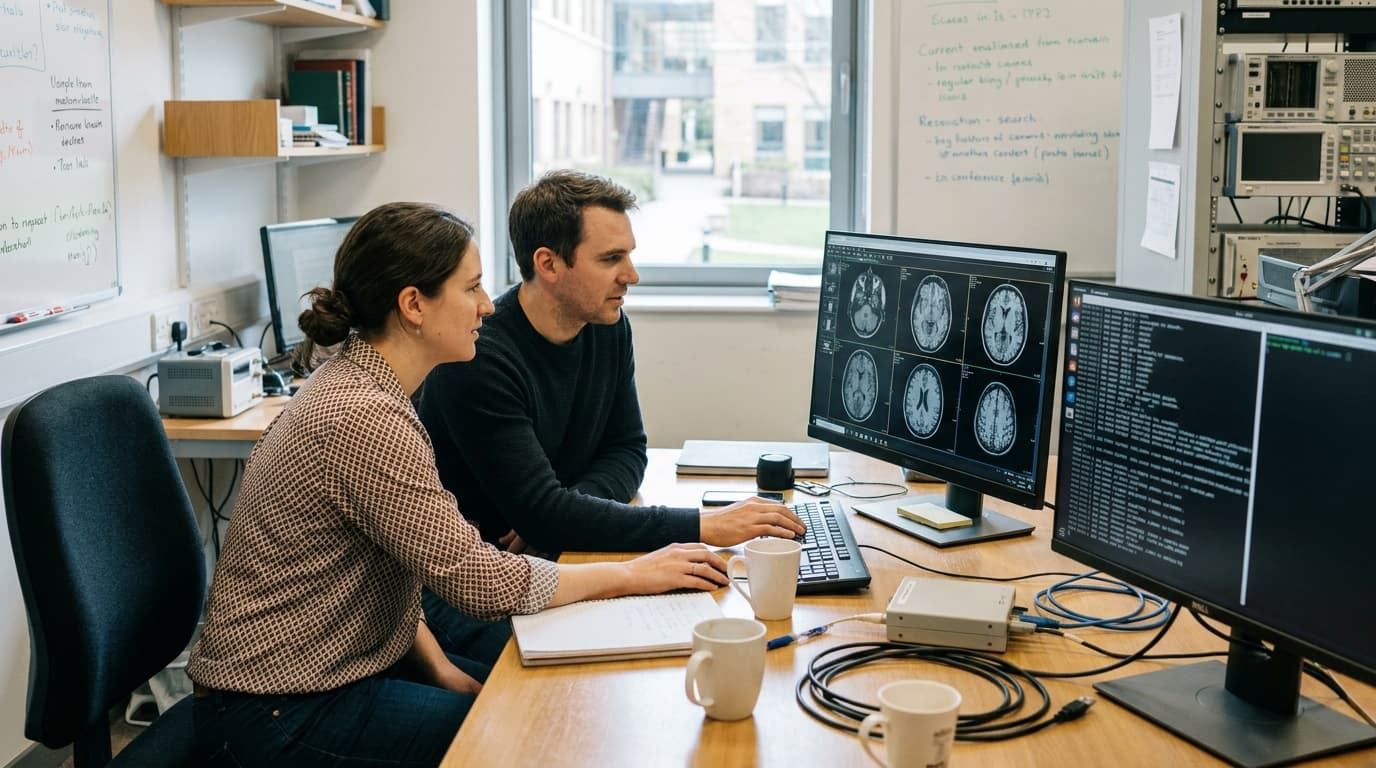
TL;DR: Microsoft Research has a new AI method that can generate testable scientific theories about how the brain processes language. This approach aims to turn AI from a "black box" into a tool for genuine scientific discovery.
Key facts
- Category
- AI
- Impact
- Medium
- Published
- Source
- Microsoft Research
Full summary
Microsoft's new AI doesn't just predict brain activity—it generates scientific theories to explain how our brains understand language.
Large language models are surprisingly good at predicting how the human brain will respond to language, but they operate as unreadable "black boxes." We get accurate predictions without any scientific theory to explain them. To solve this, Microsoft Research and the University of California, Berkeley, have developed a new method called Generative Causal Testing (GCT). This approach uses one AI model to generate simple, plain-English hypotheses about how a specific brain region functions. It then uses these hypotheses to design and simulate experiments, effectively asking the AI to explain its own reasoning in a way that scientists can test and verify. The goal is to move beyond mere prediction and toward genuine, AI-assisted scientific understanding of complex systems like the brain.
This research is a significant step forward for explainable AI (XAI). For developers, CTOs, and business leaders, the core challenge with many advanced AI systems is their lack of transparency. When a model makes a decision, it's often impossible to know exactly why. The GCT method offers a potential framework for making these systems more interpretable. By prompting models to generate their own causal theories, we could gain deeper insights into their internal logic. This has broad implications beyond neuroscience, including debugging sophisticated models, ensuring AI safety and alignment, and building greater trust in automated decision-making systems. It treats the AI not just as a tool, but as a collaborative partner in discovery.
While still in the research phase, this work points to a future where AI plays a more active role in the scientific method itself. Instead of just analyzing data, AI could help formulate new questions, propose testable theories, and even design the experiments to validate them. This could dramatically accelerate progress in fields that study highly complex systems, from biology and medicine to economics and climate science. For the tech industry, it signals a growing focus on building AI that can communicate its reasoning, moving away from purely performance-driven metrics toward models that are both powerful and understandable. This shift is crucial for the responsible development and deployment of increasingly capable AI technologies.
Related on Notifire
Related stories
Primary source: Microsoft Research