Microsoft Tests if AI Can Untie a Knot
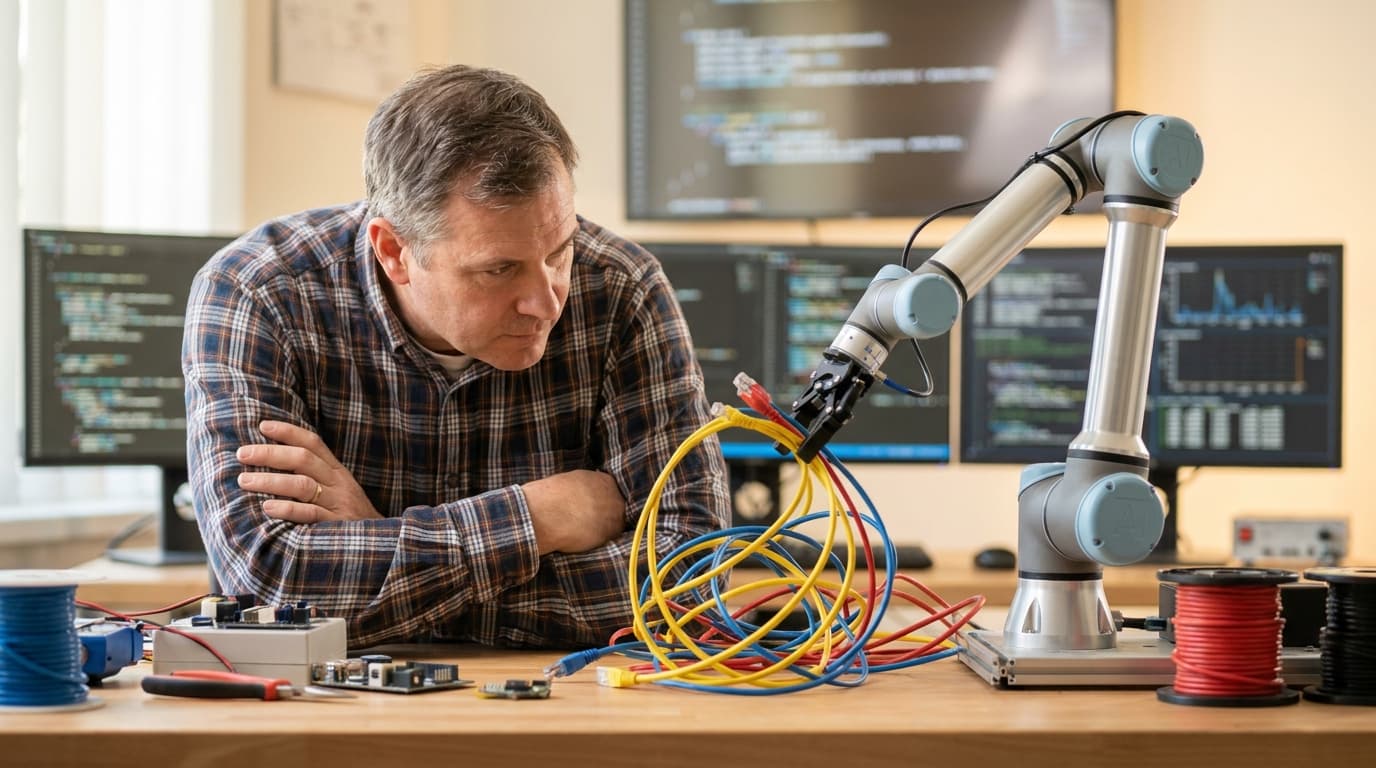
TL;DR: Microsoft Research has a new benchmark, MindTopo, to test if AI models can understand spatial relationships like knots and connections. This is a key step for building more capable robots and augmented reality applications.
Key facts
- Category
- AI
- Impact
- High
- Published
- Source
- Microsoft Research
Full summary
Microsoft's new MindTopo benchmark tests if AI can understand spatial concepts like knots, a crucial skill for robotics and augmented reality.
Microsoft Research has introduced a new benchmark named MindTopo, designed to rigorously evaluate the spatial reasoning abilities of Vision Language Models (VLMs). According to the research team, this test moves beyond simple object recognition to probe a deeper, more abstract level of understanding called topological reasoning. The benchmark assesses whether an AI can comprehend fundamental spatial relationships from an image, such as how objects are connected, if one is enclosed by another, their relative order, or how they are separated. Most notably, it even tests a model's ability to recognize and reason about complex configurations like knots. MindTopo aims to create a standardized measure for a skill that is critical for AI to interact meaningfully with the physical world, providing a clear new challenge for the developers of foundational models.
At its core, MindTopo works by testing two distinct capabilities: reasoning and planning. Topological reasoning is fundamentally different from identifying a cat in a photo; it’s about understanding that the cat is *on* the mat, or that a key is *inside* a locked box. For the reasoning component, the benchmark presents a model with a static image and asks it to describe these non-obvious relationships. The planning component represents a significant leap in complexity. It tests whether a model can not only identify a topological state, like a tangled cord, but also generate a sequence of actions required to change it, such as the specific steps to untangle the cord. This dual approach measures both passive understanding and active problem-solving, simulating the cognitive steps required for an AI to manipulate objects in a real-world environment.
For developers and CTOs, MindTopo provides a crucial new lens through which to evaluate the practical limits of current AI. While today's leading VLMs can generate impressive text and analyze images for content, their grasp of physical space and object interaction remains a significant weakness. An AI that can write code but cannot logically determine that a cup must be lifted *before* a coaster beneath it can be moved is of limited use in robotics or automated systems. This benchmark helps quantify that gap. By providing a clear score for spatial intelligence, it allows technical leaders to assess which models are genuinely progressing toward the capabilities needed for complex automation, augmented reality overlays, or physically grounded agentic systems, preventing overinvestment in models that excel at digital tasks but fail at physical logic.
The business implications of this research extend directly to the future of automation and human-computer interaction. Industries like manufacturing, logistics, and even remote surgery depend on systems that can perceive and manipulate complex 3D environments. A robot on an assembly line needs to untangle wires, and an AR system guiding a technician must understand how parts fit together. MindTopo’s existence signals that the AI industry is now seriously tackling these challenges. As models improve their scores on this benchmark, it will unlock new commercial applications that are currently impossible. The practical takeaway for business leaders is to recognize that the next wave of AI value will likely come from models that can operate in and understand the physical world, not just the digital one. Tracking progress in this area is essential for any company planning to leverage AI for real-world automation.
This development is part of a broader evolution in how the AI community measures progress. The industry has moved from early benchmarks like ImageNet, which tested object classification, to complex language challenges like the GLUE benchmark. MindTopo represents the next frontier: evaluating abstract, relational reasoning that is intuitive to humans but notoriously difficult for machines. What to watch next will be the publication of results showing how leading models from OpenAI, Google, Anthropic, and others perform on this test. These scores will offer a transparent, head-to-head comparison of their spatial reasoning skills, providing a clear signal as to which architectures are making meaningful strides toward building AI that can finally navigate the complexities of our physical world.
Related on Notifire
Related stories
Primary source: Microsoft Research