Microsoft's New AI Models Speed Up Disease Research
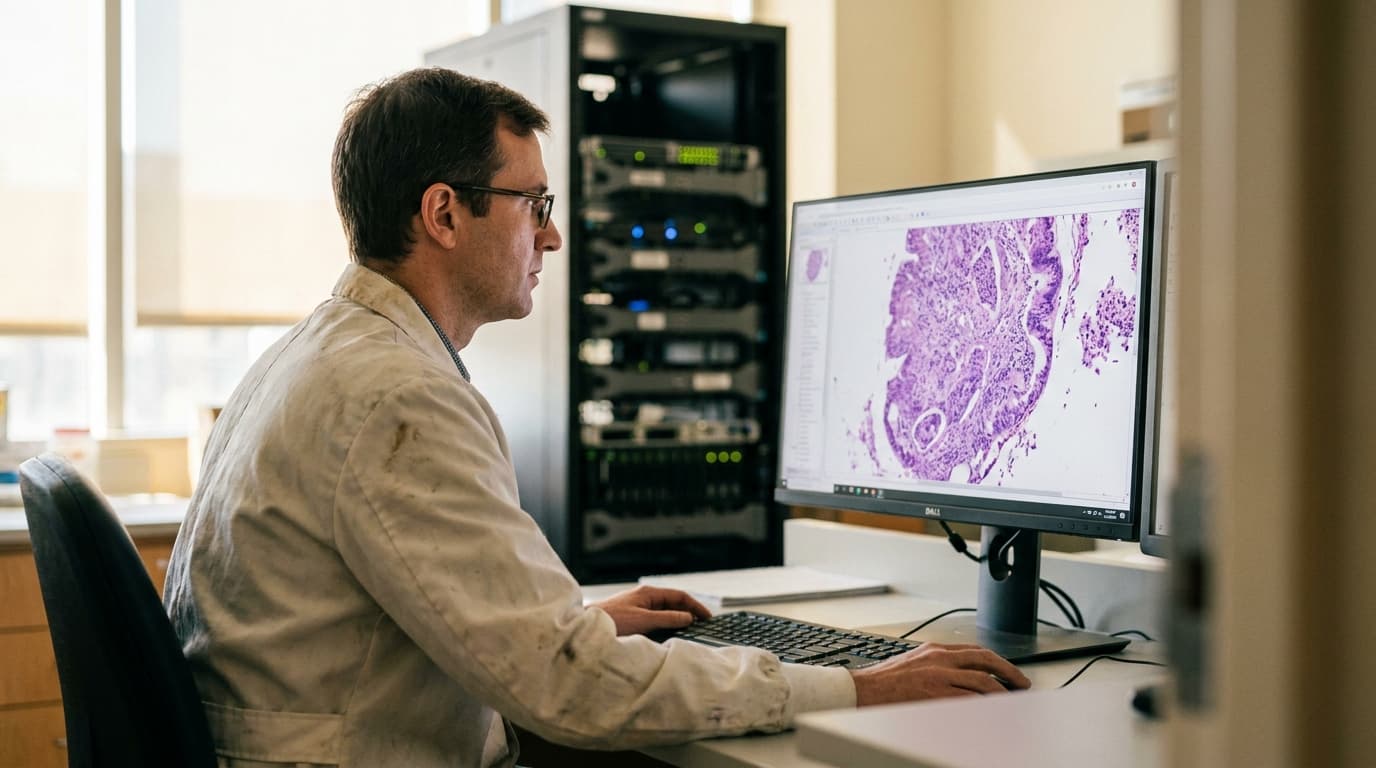
TL;DR: Microsoft Research released new AI models for pathology that are smaller and more efficient. This makes large-scale disease research faster and more affordable, opening it up to more organizations without sacrificing performance.
Key facts
- Category
- AI
- Impact
- High
- Published
- Source
- Microsoft Research
Full summary
Microsoft's new AI models lower the cost of large-scale disease research, making advanced computational pathology more accessible to all.
Microsoft Research has introduced a new, more efficient family of AI foundation models designed for computational pathology. According to the company, the GigaPath-Flash and GigaTIME-Flash models are “distilled” versions of their predecessors, meaning they are significantly smaller and require less computing power to run. This breakthrough aims to make advanced, AI-driven medical research more accessible and practical. By reducing the computational overhead, these open models allow for repeated analyses across much larger patient datasets, a crucial step for discovering new insights into diseases at a population scale. The core promise is to deliver state-of-the-art performance without the state-of-the-art price tag in terms of hardware and energy consumption.
The key technical innovation behind the “Flash” models is a process called knowledge distillation. In this approach, a large, powerful “teacher” model (the original GigaPath) is used to train a much smaller, more streamlined “student” model (GigaPath-Flash). The student model learns to mimic the outputs and internal logic of the teacher, effectively compressing its vast knowledge into a more compact and efficient form. This allows the Flash models to achieve comparable accuracy on tasks like analyzing gigapixel-sized tissue scans while being significantly faster and less resource-intensive. This efficiency is what enables the analysis of massive cohorts of patient data, something that was previously prohibitive for all but the most well-funded research institutions.
This development is particularly significant for developers, CTOs, and researchers in the health-tech sector. The high cost of GPU clusters has long been a major barrier to entry for startups and academic labs wanting to work with large-scale pathology data. By open-sourcing these efficient models, Microsoft is effectively democratizing access to cutting-edge tools for cancer research and other areas of pathology. Teams can now run complex analyses on standard hardware, accelerating development cycles and enabling new research projects that were previously out of reach. For a CTO at a health-tech startup, this could mean the difference between a project being feasible or financially impossible.
The broader business impact extends beyond just lowering costs. It signals a strategic shift in the AI industry away from a singular focus on building ever-larger general-purpose models. Instead, the trend is moving toward creating smaller, highly optimized, domain-specific models that provide a better return on investment for specialized tasks. For business leaders, the takeaway is that deploying AI doesn't always require a massive capital outlay for top-tier hardware. By leveraging efficient, purpose-built models like these, organizations can achieve powerful results more sustainably. This move also strengthens Microsoft's position in the healthcare AI ecosystem by fostering a community of researchers and developers building on its open-source technology.
Looking ahead, this approach of distilling large foundation models into efficient, task-specific versions is likely to be replicated across other scientific disciplines. We can expect to see similar “Flash” or “distilled” models emerge for genomics, materials science, and climate modeling. The focus of AI development is becoming twofold: pushing the boundaries of scale and capability with massive models, while simultaneously engineering smaller, accessible, and practical models that can be deployed widely. This dual approach will be critical for translating AI breakthroughs from the lab into real-world applications that can benefit a broader range of industries and solve practical problems.
Why it matters
This lowers the barrier to entry for advanced computational pathology, enabling smaller labs, startups, and academic researchers to conduct population-scale studies that were previously too expensive or computationally intensive.
Business impact
The release democratizes access to powerful medical AI, fostering innovation in the health-tech sector. It also highlights a key industry trend: the shift toward smaller, efficient, domain-specific models that offer a better ROI than large, general-purpose ones.
Tags
Related on Notifire
Related stories
Primary source: Microsoft Research