AI Helps Humans Solve a 30-Year-Old Math Problem
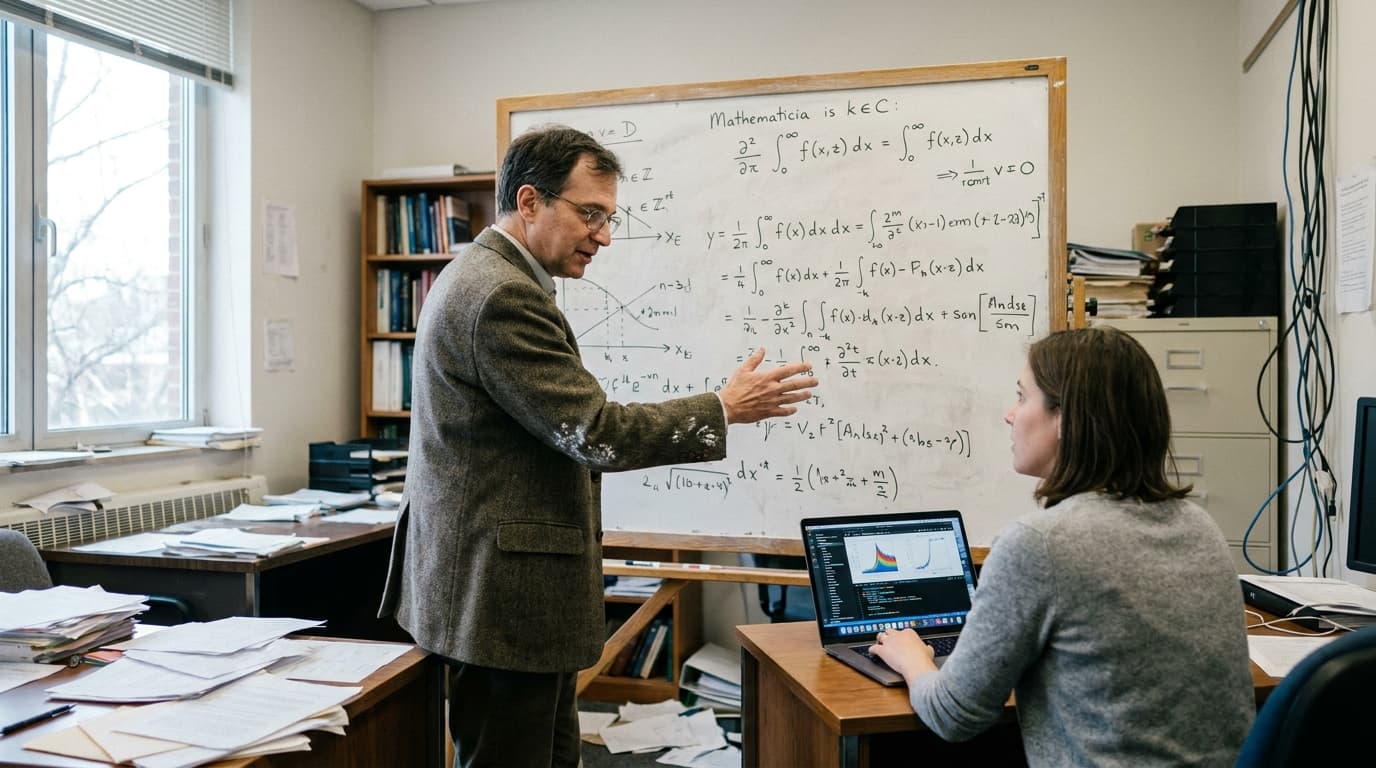
TL;DR: Microsoft researchers solved a 31-year-old math problem using a new 'human-directed AI' approach. This method shows how AI can act as a powerful collaborator for complex scientific discovery, not just a tool for automation.
Key facts
- Category
- AI
- Impact
- High
- Published
- Source
- Microsoft Research
Full summary
Researchers used a 'human-directed AI' approach to finally solve a 31-year-old grand challenge in mathematics, opening new doors for scientific discovery.
A Microsoft researcher, in collaboration with a university partner, has successfully solved the Kannan-Lovász-Simonovits (KLS) conjecture, a problem that has stumped mathematicians for over three decades. According to Microsoft Research, this breakthrough in high-dimensional geometry and probability is significant not just for its mathematical implications, but for the method used to achieve it. The solution was found by combining novel mathematical ideas with a 'human-directed AI' approach. This represents a major milestone, showcasing how artificial intelligence can move beyond simple automation to become a powerful partner in fundamental scientific discovery. For technology leaders, the story isn't about the specific conjecture, but about the new collaborative model it proves is possible between human experts and intelligent machines, opening up fresh avenues for tackling complex challenges in engineering, research, and product development.
The core innovation lies in how the researchers leveraged AI. Instead of attempting to build a general AI that could understand and solve the problem on its own, they used it as a highly sophisticated assistant. The process involved the human mathematician developing new theoretical frameworks and then directing the AI to search for potential pathways or counterexamples within those frameworks. The AI could explore vast, complex mathematical spaces and identify promising patterns far faster than any human could. The human expert then interpreted the AI's findings, refined the search parameters, and integrated the computer-generated insights into a rigorous, human-understandable proof. This symbiotic relationship, where human intuition guides the AI's brute-force search capabilities, is the essence of the 'human-directed AI' model. It’s a partnership that amplifies the strengths of both the human and the machine, allowing them to navigate complexity that would be insurmountable for either one alone.
This achievement fits into a broader trend of AI becoming an indispensable tool in scientific research, but it also carves out a new niche. For years, AI has been used to analyze massive datasets, as seen in fields like genomics or particle physics. More recently, models like DeepMind's AlphaFold have demonstrated AI's ability to solve specific, well-defined problems like protein folding. The resolution of the KLS conjecture pushes this boundary further into the realm of pure, abstract reasoning. It suggests a 'centaur' model—part human, part machine—is becoming viable for theoretical sciences. This approach differs from simply using a computer to check a proof, like in the case of the four-color theorem. Here, the AI was an active participant in the discovery process, helping to generate the ideas that formed the proof itself. This signals a maturation of AI from a data-crunching tool to a creative collaborator in abstract problem-solving.
For founders, CTOs, and engineering leads, this breakthrough serves as a powerful proof of concept for a new class of R&D tools. It highlights the potential for AI to augment, not replace, high-level expertise. Companies can begin to explore how similar human-in-the-loop AI systems could accelerate their own innovation cycles. This could involve developing tools to help engineers explore vast design spaces for new hardware, debug complex distributed systems, or even discover novel algorithms. The key takeaway is to shift the mindset from viewing AI as a pure automation play to seeing it as a force multiplier for expert talent. The next frontier will be the development of platforms and tools that make this 'human-directed AI' approach accessible not just to elite researchers, but to engineering and product teams working on everyday commercial challenges. Watching how this collaborative paradigm is applied to other fields, from materials science to drug discovery, will be critical for staying at the competitive edge.
Why it matters
This demonstrates a new, powerful paradigm for AI in research and development. For engineers and CTOs, it signals that AI's future isn't just automation, but a collaborative tool that can augment human experts to solve previously intractable problems in science and engineering.
Business impact
This 'human-directed AI' approach creates a new competitive advantage for R&D-intensive companies. Businesses that adopt this model can accelerate innovation, solve complex product design challenges faster, and potentially achieve breakthroughs that were previously out of reach.
Tags
Related on Notifire
Related stories
Primary source: Microsoft Research