AI Teaches a 6-Ton John Deere to Do Wheelies
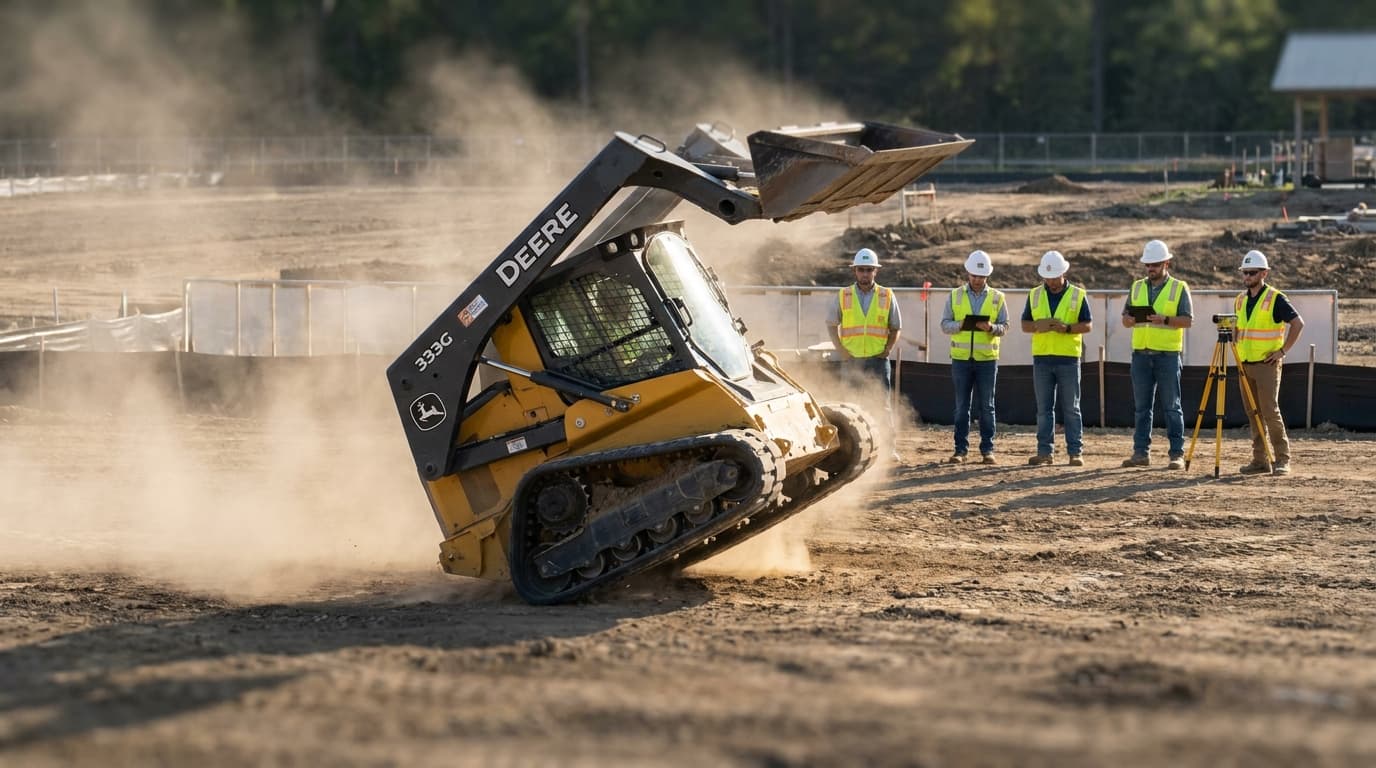
TL;DR: Researchers taught a 12,000-pound John Deere loader to balance and spin on two wheels using AI. The machine learned the complex moves in a simulation before performing them in the real world, signaling a leap for autonomous machinery.
Key facts
- Category
- AI
- Impact
- High
- Published
- Source
- TechRadar
Full summary
Researchers used AI to teach a 12,000-pound John Deere construction loader to balance and spin on just two wheels.
A 12,000-pound John Deere skid-steer loader, a machine typically used for digging and hauling, can now balance on two wheels and perform pirouettes. This feat was achieved not by a stunt driver but by an artificial intelligence system developed by researchers. As reported by TechRadar, the heavy construction vehicle learned these complex acrobatic maneuvers without a human operator, demonstrating a new level of dynamic control for industrial machinery. The machine can maintain its balance even while spinning on uneven surfaces, showcasing the robustness of the AI controller. This project pushes the boundaries of what autonomous systems can accomplish with standard industrial hardware, moving far beyond simple, repetitive tasks into the realm of complex physical agility.
At the core of this achievement is a technique called reinforcement learning, specifically using a method known as simulation-to-reality (sim-to-real) transfer. Instead of training the AI on the physical loader—a process that would be slow, dangerous, and expensive—researchers first built a highly accurate digital twin of the vehicle in a computer simulation. Within this virtual environment, the AI agent could practice the balancing act millions of times in accelerated time. It learned through trial and error, receiving digital “rewards” for actions that led to stable balancing and “penalties” for falling over. The critical innovation was developing a simulation so precise that the skills learned by the AI could be directly transferred to the real-world loader with minimal adjustments. This successful transfer is a significant technical hurdle, especially for a system as complex and inherently unstable as a six-ton vehicle on two wheels.
While acrobatic robots are not entirely new—Boston Dynamics’ Atlas robot is famous for its parkour and backflips—this project is significant for a different reason. It applies advanced dynamic control to a commercially available piece of heavy industrial equipment, not a custom-built, humanoid research platform. This signals a shift from bespoke robotics demonstrations to practical applications in industries like construction, agriculture, and logistics. The ability to control such a massive, unwieldy machine with this level of precision suggests that the underlying AI techniques are maturing rapidly. It bridges the gap between the agile robots seen in labs and the powerful but often clumsy machinery used on job sites, hinting at a future where autonomous systems are not just automated but also highly adaptive and physically capable, able to react to and navigate unpredictable environments.
For developers, CTOs, and founders, this is more than just a cool demo; it is a proof-of-concept for the future of autonomous physical systems. The project validates that reinforcement learning and sim-to-real pipelines can solve extremely challenging, real-world control problems on an industrial scale. This opens up possibilities for industrial vehicles that are safer and more efficient. For example, an autonomous excavator could automatically correct itself to prevent a rollover on a steep incline, or a warehouse forklift could navigate tight spaces with greater agility. The next step will be to see these dynamic control capabilities move from stunts to practical tasks. We should watch for this technology to be integrated into commercial systems to handle complex terrain navigation, object manipulation, and dynamic self-stabilization, ultimately leading to more resilient and capable autonomous workforces.
Why it matters
This demonstrates a major leap in sim-to-real reinforcement learning for heavy machinery. Successfully transferring such a highly unstable, dynamic control task from simulation to a 12,000-pound vehicle proves the maturity of these AI techniques for complex, real-world robotics challenges beyond controlled lab environments.
Business impact
This breakthrough signals that advanced automation is coming to heavy industries like construction and logistics. Companies can anticipate autonomous vehicles with far greater agility and safety, capable of operating in complex environments, potentially reducing labor costs and improving operational efficiency on job sites.
Tags
Related on Notifire
Related stories
Primary source: TechRadar