Why Boston Dynamics Put Its Humanoid Robot on Wheels
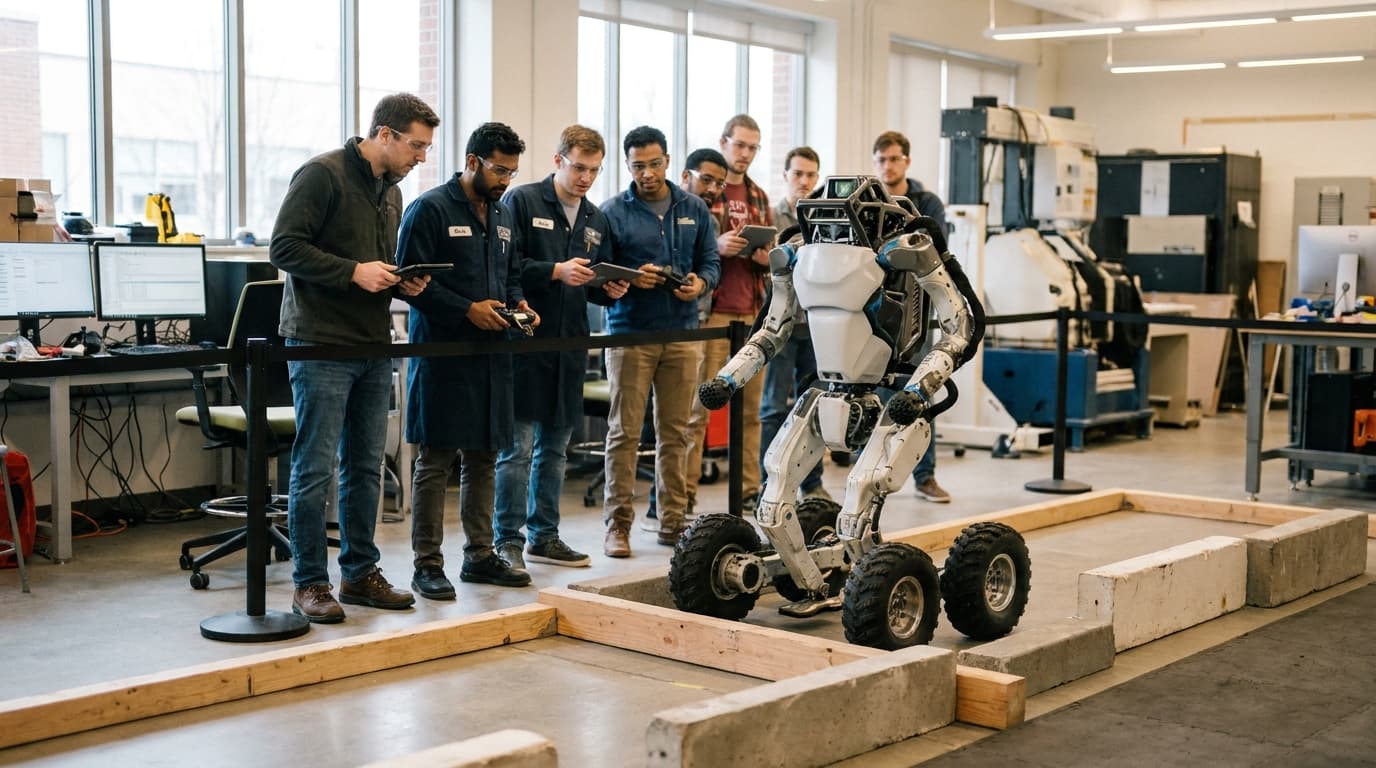
TL;DR: Boston Dynamics has added wheels to its Atlas humanoid, creating a hybrid system. The robot can now roll quickly on flat surfaces while still using its legs to step over obstacles and handle uneven terrain.
Key facts
- Category
- AI
- Impact
- High
- Published
- Source
- Slashdot
Full summary
Boston Dynamics' Atlas robot now uses wheels for speed and legs for agility, blending rolling and walking to navigate complex environments.
Boston Dynamics has revealed a significant update to its famous Atlas humanoid robot: it now has wheels. According to a report from The Robot Report, the company has equipped the robot with simple, non-powered wheels on its feet, creating a hybrid locomotion system. This modification allows Atlas to roll efficiently across flat ground, achieving much higher speeds than walking would allow. At the same time, it retains its articulated legs to step over obstacles, climb curbs, and navigate uneven surfaces where rolling is impossible. The experiment showcases a practical approach to making humanoid robots more versatile and efficient for real-world tasks, blending the strengths of both wheeled and legged movement into a single, dynamic platform.
The true innovation lies in the robot's control system, which enables it to seamlessly manage these two distinct modes of transport. The system combines classical, model-based motor control with advanced, whole-body reinforcement learning (RL). The classical control handles the predictable physics of motion, while the RL component allows the robot to learn and adapt to unpredictable situations in real-time. This AI-driven approach is crucial for maintaining dynamic stability, especially during transitions between rolling and stepping or when encountering unexpected terrain. This successful use of sim-to-real transfer, where the control policies are trained in a virtual environment before being deployed on the physical robot, represents a key milestone for applying modern AI techniques to complex hardware.
This development fits into a broader industry trend toward creating more general-purpose robots. For years, robotics has been dominated by specialized machines: wheeled robots like Amazon's Proteus excel in the structured environment of a warehouse, while legged robots like Boston Dynamics' own Spot are designed for unstructured terrain like construction sites. Each is highly effective in its domain but limited outside of it. By creating a hybrid, Boston Dynamics is exploring a middle ground that could unlock new applications. A single robot could potentially move goods quickly across a factory floor and then climb stairs to make a delivery, bridging the gap between two previously separate operational domains and reducing the need for multiple types of specialized robots.
For developers and technical leaders, this experiment is a powerful demonstration of how sophisticated software can unlock new capabilities from relatively simple hardware changes. The focus is shifting from building ever-more-complex mechanical systems to developing smarter, more adaptive control algorithms. The success of the reinforcement learning model in this context suggests that AI will be the primary driver of robotic advancement going forward. The next step to watch for is how this technology matures. While still an experiment, this hybrid approach could eventually find its way into commercial robots for logistics, inspection, and security, creating machines that are not only agile but also fast and efficient enough for widespread industrial adoption.
Why it matters
This demonstrates a major advance in hybrid locomotion, successfully merging classical motor control with reinforcement learning. For robotics and AI engineers, it's a powerful case study in sim-to-real transfer for creating versatile, real-world navigation systems with relatively simple hardware changes.
Business impact
This hybrid approach could dramatically expand the use cases for mobile robots in logistics, manufacturing, and inspection. Companies can expect more versatile and efficient automation solutions that handle both structured warehouse floors and unstructured outdoor or construction environments, increasing operational speed.
Related on Notifire
Related stories
Primary source: Slashdot