Independence Day and Republic Day are two of the most widely celebrated national holidays in India. Every year, we see flag hoistings, patriotic songs, and speeches—but have you ever stopped to think about what each day actually means? You’re not alone if you haven’t.
Surprisingly, many people across the country still don’t clearly know the difference between Independence Day and Republic Day. While both days fill us with pride and love for our nation, they celebrate two completely different events in Indian history. One marks our freedom, the other our identity as a democratic republic.
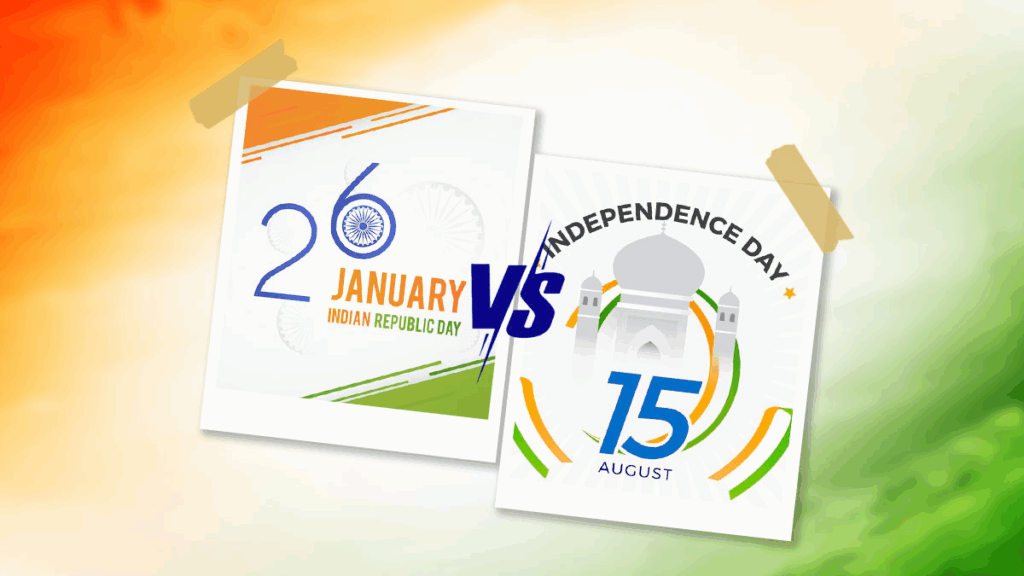
Independence Day for Freedom & Republic Day for
What Does Independence Day Signify?
Independence Day, celebrated on 15th August every year, marks the day India became free from British colonial rule in 1947. It is a symbol of India’s hard-earned freedom after a long struggle led by leaders like Mahatma Gandhi, Bhagat Singh, Sardar Patel & Subhas Chandra Bose. and many more. On this day, India took its first step as an independent nation, free to make its own decisions.
The Prime Minister hoists the national flag at the Red Fort in Delhi and addresses the nation, remembering the sacrifices of freedom fighters. Across the country, schools, offices, and communities hold flag-hoisting ceremonies, cultural events, and parades.
Why Do We Celebrate Republic Day?
Republic Day, celebrated on 26th January, commemorates the day India adopted its Constitution in 1950. While India gained independence in 1947, it did not have a permanent constitution. The country was still governed under British laws until the Indian Constitution came into effect.
This day represents the transition of India into a sovereign, democratic republic. It highlights the values of equality, justice, and liberty. The main celebration is held at Rajpath in New Delhi, where the President of India hoists the flag and a grand parade showcases India’s military strength, cultural heritage, and technological progress.
When Did Each Event Happen?
The difference between Independence Day and Republic Day lies in their historical timelines:
- Independence Day: 15th August 1947 – India gained freedom from British rule.
- Republic Day: 26th January 1950 – The Constitution of India came into force.
These two dates are etched in Indian history for different reasons—freedom and governance.
How Are They Observed in India?
Independence Day and Republic Day are observed with great national pride, but their celebrations differ in tone and scale:
- On Independence Day, the Prime Minister delivers a speech from the Red Fort, and patriotic events are held across the country.
- On Republic Day, the President takes the salute during the grand parade in New Delhi, which includes cultural tableaux from different states, performances, and a showcase of military power.
Both days are declared national holidays and involve participation from people across all walks of life.
What Values Does Each Day Represent?
While Independence Day celebrates freedom from foreign rule, Republic Day honors democracy, law, and constitutional values. Together, they remind us of our duty as citizens to protect the unity, integrity, and democratic spirit of the nation.
These two occasions highlight the difference between Independence Day and Republic Day, yet they both reinforce our identity as proud Indians.
For more simple and informative reads on national events, visit Notifire.in – your go-to platform for current affairs and educational insights.