157 Petabytes Now Fit in a Single Server Rack
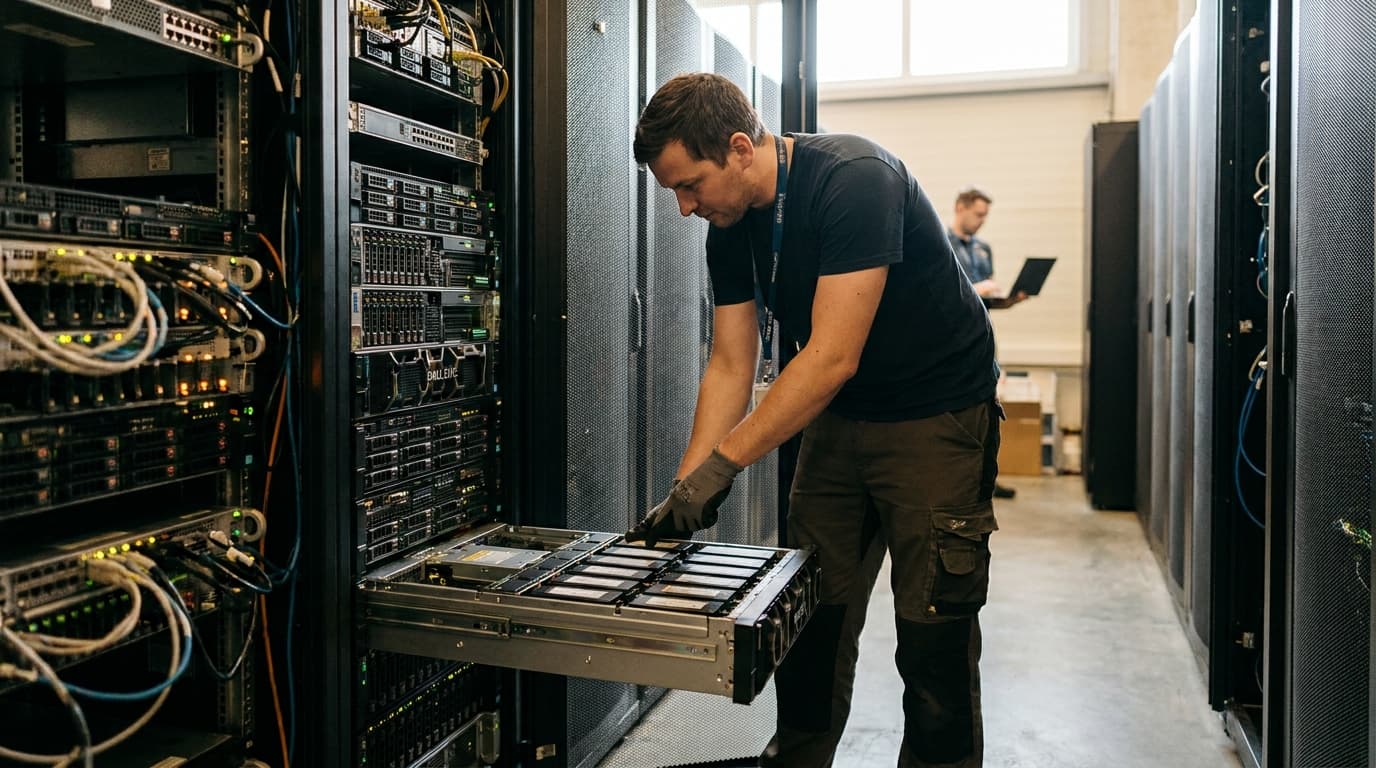
TL;DR: Kioxia and Dell created a system packing 157 petabytes of flash storage into one server rack. This massive density helps companies manage growing data for AI and big data without needing more physical space.
Key facts
- Category
- Infrastructure
- Impact
- High
- Published
- Source
- TechRadar
Full summary
Kioxia and Dell have packed 157 petabytes of flash storage into a single server rack, a new milestone for data center density.
Kioxia and Dell Technologies have achieved a significant milestone in data storage, demonstrating a new level of density within a standard data center footprint. According to a report from TechRadar, the two companies successfully configured a single 42U server rack to hold 157 petabytes of raw flash storage. This was accomplished by integrating 640 of Kioxia's high-capacity solid-state drives (SSDs) into a set of 16 Dell PowerEdge servers. The entire server installation occupies just 32 units (32U) of the rack, leaving a notable 10U of space available for networking gear or other essential hardware. This achievement showcases a practical solution to one of the biggest challenges facing modern IT: the ever-increasing demand for storage capacity within the physical constraints of existing data centers.
The technical foundation of this high-density configuration is the synergy between Kioxia's advanced flash memory and Dell's specialized server hardware. The system utilizes 16 Dell PowerEdge R7725xd servers, a model specifically designed for dense storage applications. These servers provide the necessary drive bays, power, and cooling infrastructure to support a large number of SSDs in a compact 2U chassis. The real innovation lies in the successful integration and stable operation of 40 high-capacity SSDs per server, multiplied across the 16 units. This required careful engineering to manage the immense heat output and power draw of 640 drives operating in close proximity. The system validates that modern server backplanes and thermal management systems can handle this extreme density, paving the way for deploying massive storage pools without resorting to sprawling, less efficient hardware configurations.
This development arrives at a critical time for the technology industry. The explosive growth of artificial intelligence, machine learning, and large-scale data analytics has created an insatiable appetite for fast, accessible storage. Training large language models and processing vast datasets for business intelligence requires petabytes of data to be readily available. However, data center space is a premium and costly resource, and expanding a physical footprint is often impractical or prohibitively expensive. This Kioxia and Dell collaboration directly addresses this tension. It follows a long-term industry trend of increasing storage density, which began with the transition from bulky spinning hard drives to more compact SSDs. This new configuration represents a leap forward, demonstrating that it is possible to scale data capacity vertically within a single rack rather than horizontally across many.
For CTOs, IT managers, and infrastructure architects, this achievement serves as a powerful indicator of the future of on-premise and co-located data storage. While this specific 157-petabyte configuration may be a high-end proof of concept, it signals that extremely dense, all-flash storage solutions are becoming a viable strategy for managing data growth. Organizations planning their next three-to-five-year infrastructure roadmaps should anticipate the availability of similar high-density platforms. The key takeaway is that future capacity planning may rely less on acquiring more floor space and more on upgrading to denser hardware within the existing footprint. The next developments to watch will be the cost-per-petabyte of these systems as they mature, as well as the evolution of software-defined storage platforms needed to effectively manage and orchestrate such massive, concentrated pools of flash resources. We can also expect competing hardware vendors to announce their own answers to this new density benchmark.
Why it matters
For engineers and CTOs, this demonstrates a viable path to scale storage for massive AI models and data lakes within existing data center footprints. It directly addresses the physical space, power, and cooling constraints that often limit infrastructure growth.
Business impact
This level of storage density allows businesses to significantly reduce their data center costs per terabyte. It enables scaling AI and analytics workloads without expensive physical expansion, offering a competitive advantage in managing operational expenses and future growth.
Related on Notifire
Related stories
Primary source: TechRadar