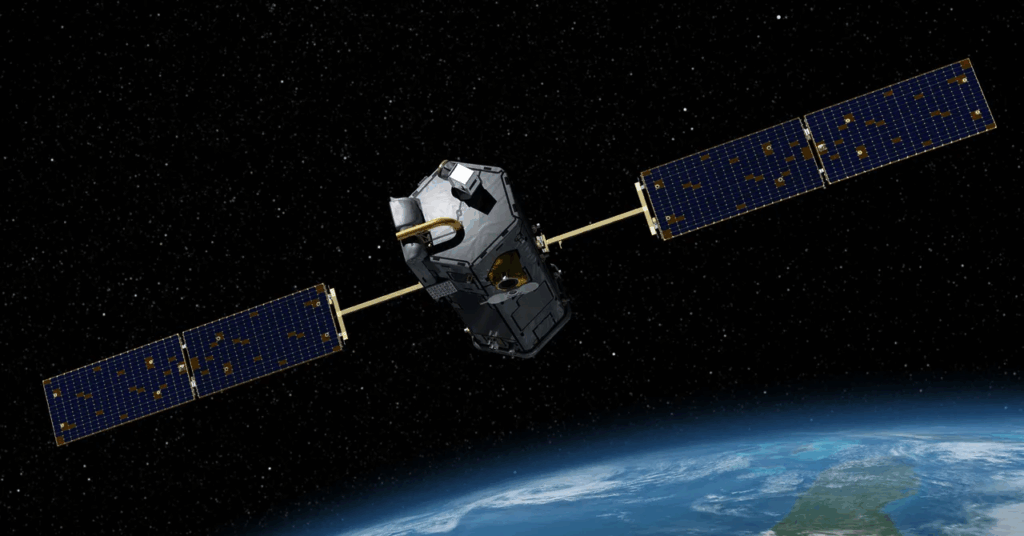
The Orbiting Carbon Observatory is one of NASA’s most important space missions designed to study Earth’s atmosphere and track carbon dioxide (CO₂) levels with precision. Launched to help scientists better understand the role of CO₂ in climate change, this satellite provides valuable data for atmospheric CO₂ monitoring. By observing the planet from space, the mission supports global efforts to address environmental challenges and guide climate policies.
Understanding the Orbiting Carbon Observatory Mission (OCO)
The NASA Orbiting Carbon Observatory (OCO) mission was developed to measure carbon dioxide concentrations in Earth’s atmosphere on a global scale. CO₂ is the primary greenhouse gas responsible for global warming, and tracking its sources and absorption patterns is critical for climate research. OCO satellites orbit the Earth in a sun-synchronous path, collecting continuous data to help scientists create accurate climate models.
Funding and How It’s Used
The Orbiting Carbon Observatory is funded primarily by NASA’s Earth Science Division, which receives its budget from the United States federal government through the annual NASA budget approved by Congress. The OCO program’s initial development and launch cost was around $278 million, with additional funding allocated for satellite operations, data analysis, and research collaborations.
This funding is used for:
- Building and maintaining the satellite and instruments.
- Launch operations and mission control activities.
- Data collection, processing, and public distribution.
- International collaborations with space agencies and climate research institutions.
NASA also partners with agencies like the Japan Aerospace Exploration Agency (JAXA) and the European Space Agency (ESA) to share data and reduce costs.
How OCO Measures Atmospheric CO₂
The Orbiting Carbon Observatory uses advanced spectrometers that detect how sunlight reflects off Earth’s surface and is absorbed by CO₂ molecules in the air. This allows the satellite to measure atmospheric carbon dioxide levels with high accuracy. By covering vast areas quickly, OCO provides data that ground-based systems cannot achieve, making it an essential part of global climate change satellites technology.
Scientific Insights from OCO Data
Data from the NASA OCO mission has revealed important trends in CO₂ levels, such as seasonal changes, regional emissions, and the impact of human activity. The satellite has also helped scientists understand how forests, oceans, and other ecosystems absorb carbon dioxide. This information is vital for predicting future climate scenarios and planning strategies to reduce greenhouse gas emissions.
The Role of OCO in Climate Research
The Orbiting Carbon Observatory plays a crucial role in international climate studies. Governments and researchers use its data to monitor whether emission reduction commitments are being met. OCO data also supports the work of the Intergovernmental Panel on Climate Change (IPCC) and other organizations, ensuring that climate policy decisions are based on accurate, real-time science.
Challenges Facing the OCO Mission
Despite its success, the NASA OCO mission faces challenges such as the limited lifespan of satellites, potential technical malfunctions, and funding constraints. Harsh space conditions and the need for constant calibration also add complexity to long-term atmospheric monitoring.
The Future of Carbon Monitoring Satellites
NASA plans to expand its fleet of climate change satellites to improve global carbon tracking. The next generation of satellites will have enhanced sensors, higher resolution, and the ability to monitor other greenhouse gases like methane. These advancements will strengthen efforts to combat climate change and protect Earth’s ecosystems.
The Orbiting Carbon Observatory continues to be a cornerstone of climate science, proving that space technology is not just about exploring distant planets, but also about protecting our own.
Stay tuned woth Notifire for more updaes.
Sources: GK Today.