Noah Lyles won the men’s 100-meter sprint gold at the 2024 Paris Olympics with a razor-thin margin of 0.005 seconds over Jamaica’s Kishane Thompson, ending a 20-year drought for American sprinters in this event.
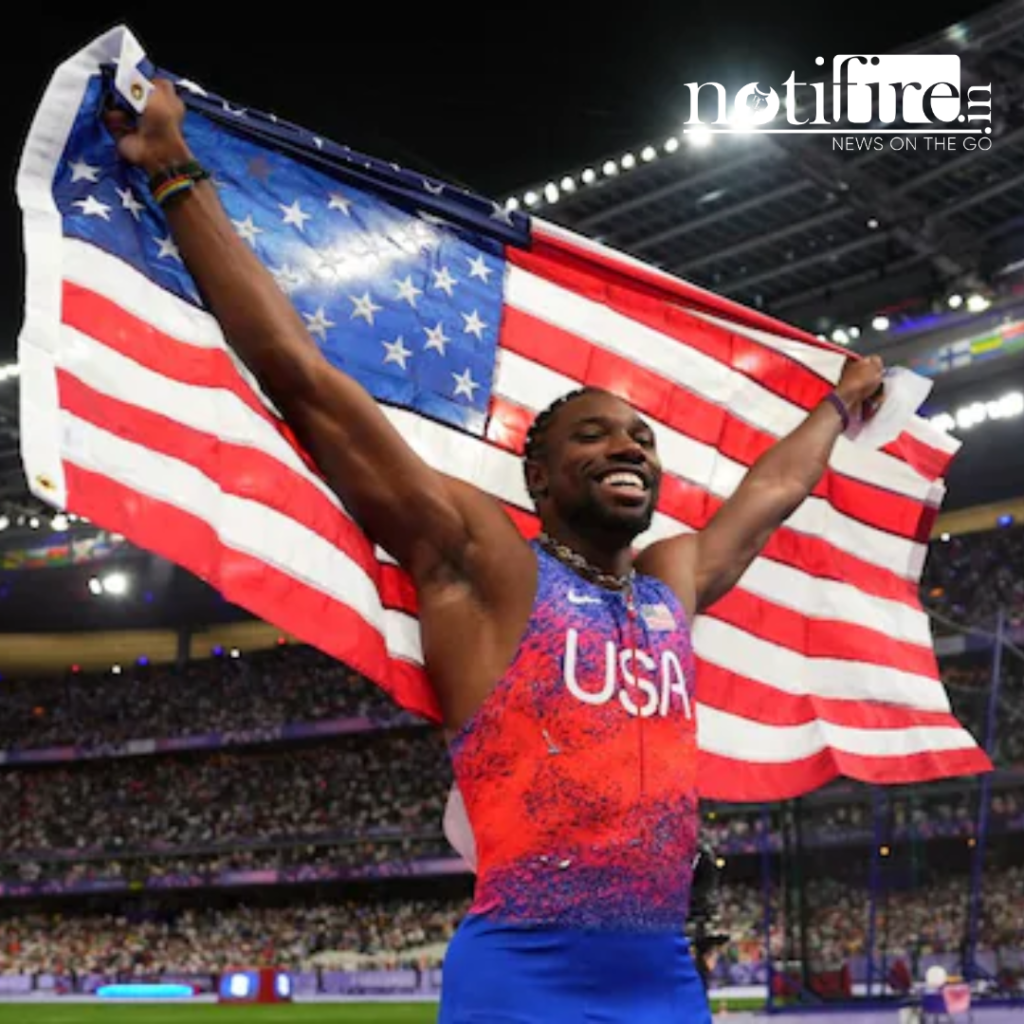
American sprinter Noah Lyles clinched gold in the men’s 100-meter sprint at the 2024 Paris Olympics. The race was one of the closest in Olympic history, with Lyles finishing just 0.005 seconds ahead of Jamaica’s Kishane Thompson. Lyles’ time of 9.784 seconds narrowly beat Thompson’s 9.789 seconds. Team USA’s Fred Kerley secured bronze with a time of 9.81 seconds.
First U.S. Gold Since 2004
Lyles’ victory marks the first time an American has won the 100-meter gold since Justin Gatlin in Athens 2004. This race also saw a historic number of seven men finishing under 9.90 seconds, shattering the 10-second barrier.
Dramatic Finish and Celebration
Despite a slow start, Lyles surged in the final stretch, overtaking competitors and crossing the finish line in a dramatic photo finish. The excitement was amplified by a raucous crowd at Stade de France. Post-race, Lyles celebrated with his signature “Kamehameha” pose and expressed disbelief at his win.
Lyles’ Olympic Journey
Previously, Lyles won bronze in the 200-meter at Tokyo 2020 and is now seeking further success in the 200-meter and 4×100-meter relay at Paris. His triumph in the 100-meter sprint adds to his accolades from the 2023 World Athletics Championships where he won gold in the 100-meter, 200-meter, and 4×100-meter relay.
Lyles aims to replicate the sprint treble achieved by Usain Bolt in Rio 2016 and Carl Lewis in Los Angeles 1984. With his strong performance in Paris, he remains a dominant figure in sprinting, looking to build on his success in upcoming events.
Virginia’s Noah Lyles took the gold in the men’s 100-meter final for Team USA at the Paris Olympics on Sunday.
Why it matters: The win makes him the fastest man in the world.
The big picture: Lyles, who grew up in Alexandria and graduated from Alexandria City High School, is also the first American to earn the title in 20 years.
- He won with a time of 9.784 seconds and by five-thousandths of a second.
- The race between him and Jamaica’s Kishane Thompson was so close that Lyles originally told him “I think you got the Olympics, dog.”
- But a photo finish camera captured Lyles’ torso passing the line first, which is the metric Olympic rules and regulations use to declare a winner.
Shortly after his win, he posted on Instagram with the caption “America, I told you I got this!”
- And then said on X, “I have asthma, allergies, dyslexia, ADD, anxiety, and depression.”
- “But I will tell you that what you have does not define what you can become. Why Not You!”
The latest: Lyles won the sixth heat of the men’s 200-meter race on Monday and advanced to the semifinals on Wednesday at 2:02pm.
Noah Lyles rocked back and forth impatiently in front of his starting blocks before the Olympic Games 100-meter final Sunday night and then took a step and then another in front of the starting line, as if he had waited long enough.
He outstretched both his hands in front of him at mid-chest level, both palms up and curling his fingers back and forth in a beckoning movement, seeming to say bring it on, bring it on.
Bring on all the doubts, the conventional wisdom that he didn’t have the start to claim sprinting’s greatest prize.
Bring on the ghosts of Tokyo.
Bring on the fastest men on the planet.
Lyles was ready.
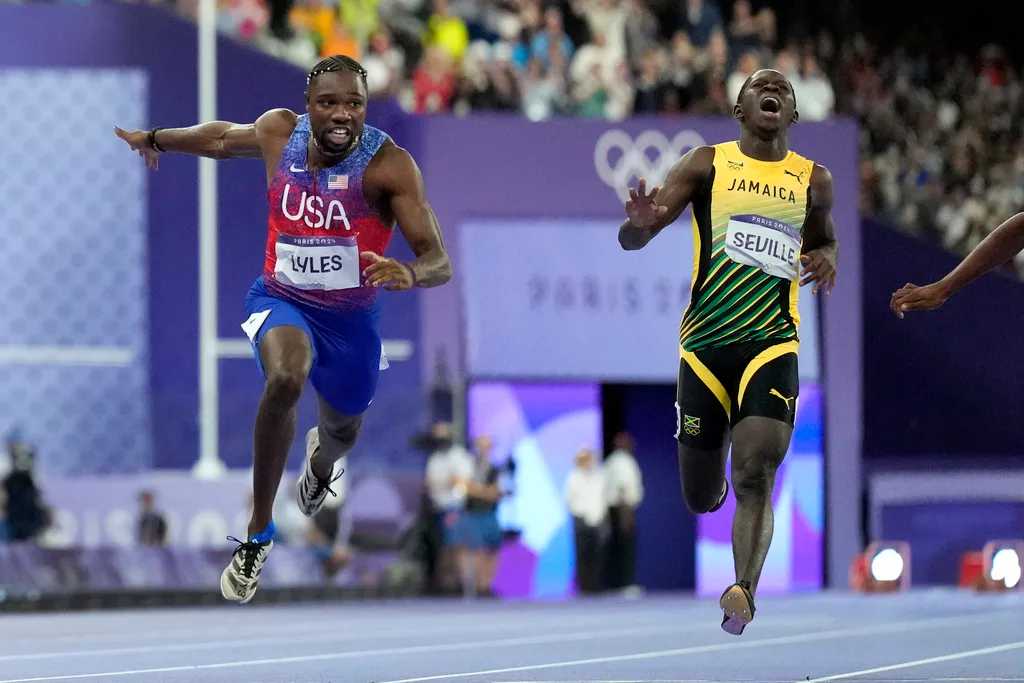
Lyles, fulfilling the promise the sport first recognized more than a decade ago, taking it all on, the doubts and the demons, won the closest Olympic 100 final in history by a mere five-thousandths of a second on a night at Stade de France that was worth the three-year wait.
Lyles, last out of the starting blocks, didn’t claim the first Olympic 100 gold medal won by an American man since 2004 until the last step of the race, out-leaning Jamaica’s Kishane Thompson at the finish line.
“I couldn’t see him, but I thought he was seeing me,” Thompson said later.
“Hey, Kishane I thought you got it,” Lyles told the Jamaican.
“I am not sure,” Thompson replied.
Both men and a sold out stadium had to wait several moments for a review of the photo finish to separate them, “PHOTO” listed next to seven of the eight names on the scoreboard, only Jamaica’s Oblique Seville, last in eighth place, receiving a time and a place.
“It was a crazy moment,” said Lyles, the reigning World 100 and 200 champion. “I did think Kishane had that and I was like, ‘I’m going to have to swallow my pride,’ which I don’t have a problem doing. Everybody on the field came out knowing they could win this race. That’s the mindset we have to have. Iron sharpens iron.”
Finally, the scoreboard went blank and then flashed the first two finishers.
1. Lyles 9.79
2. Thompson 9.79.
While both men were officially clocked in 9.79, the photo finish, going down to the thousandths of a second, gave Lyles a 9.784 to 9.789 edge.
“I saw my name,” Lyles said, “and was like, ‘I didn’t do this against a slow crowd, I did this against the best of the best, on the biggest stage with the biggest pressure.’ I thought, ‘Oh, my gosh, there it is.’
“I wasn’t even in the 100 meters in 2021. First Olympics in the 100 meters. Having the title, not just at world champs but at the Olympics, of world’s fastest man.”
The battle for the bronze medal was nearly as close, with Fred Kerley, Lyles’ U.S. teammate, edging South Africa’s Akani Simbine 9.81 and 9.82.
With the victory Lyles, 27, kept alive his hopes of becoming the first man not named Usain Bolt to sweep the Olympic 100 and 200 titles since Carl Lewis did it in Los Angeles 40 years ago.
“Pretty confident, can’t lie,” Lyles said when asked how he feels about the 200. “Kenny’s (Team USA’s Kenny Bednarek) definitely not going to take how he did here in the 100 meters lying down. He’s going to say, ‘I’m going after it in the 200 meters.’ My job is to make sure …” Lyles paused.
“I’ll just leave it there. I’ll be winning.
“None of them is winning.”
Lyles came to Paris fresh off a personal best 9.81 victory at London’s Diamond League meet last month. At last summer’s World Championships in Budapest, he became the first American to win the 100 and 200 titles since 2007. It was his third consecutive World 200 gold medal.
But the Olympic double gold in Paris had always been his primary target, a triumph, Lyles said, that had “been years in the making.”
“It’s been a rollercoaster, ups and downs,” said Lyles, the overwhelming favorite to win the Olympic 200 three years ago in Tokyo only to finish third. He then unburdened himself in an emotional and tearful stream-of-consciousness account of his battles with ADD, dyslexia and bullying as a child and depression as a young adult.
He was asked when he set his sights on the 100 gold medal.
“The journey started after 2021 when I received this,” Lyles said in the post-race press conference, pulling out his Olympic 200 bronze medal from Tokyo. “I said I’ve got to evolve. I’m not going to feel the same every time I step on the track. I don’t feel the same now as I did in Budapest (at the 2023 World Championships when he won the 100m and 200m). I felt I was coming in as the favorite for this one. I was like, ‘Shoot, these guys are ready, I got to be ready. All I need is a lane, and I’ll go out to prove who I am.’”
.But Seville edged Lyles 9.82 to 9.85 in Kingston on June 1 and Thompson clocked a world leading 9.77 at the Jamaican Olympic Trials in June.
Sunday night Seville nipped Lyles again in their semifinal, 9.81 to 9.83. The final was delayed several minutes while security detained a protester wearing a “Free Palestine, Free Ukraine” t-shirt who had tried to get on the track.
“I didn’t see anyone trying to get on the field,” Lyles said. “I was wondering what we were waiting for. The crowd was getting more and more hyped.”
So was Lyles.
“I wouldn’t say nervous,” he said. “I was extremely curious to what was going to happen. How am I going to pull this off? I came in third fastest from the semis. I’m like, ‘This is going to get serious, this is not going to be easy.’ My therapist said, ‘You need to let go, be yourself.’ It was the energy that I’m looking for.”
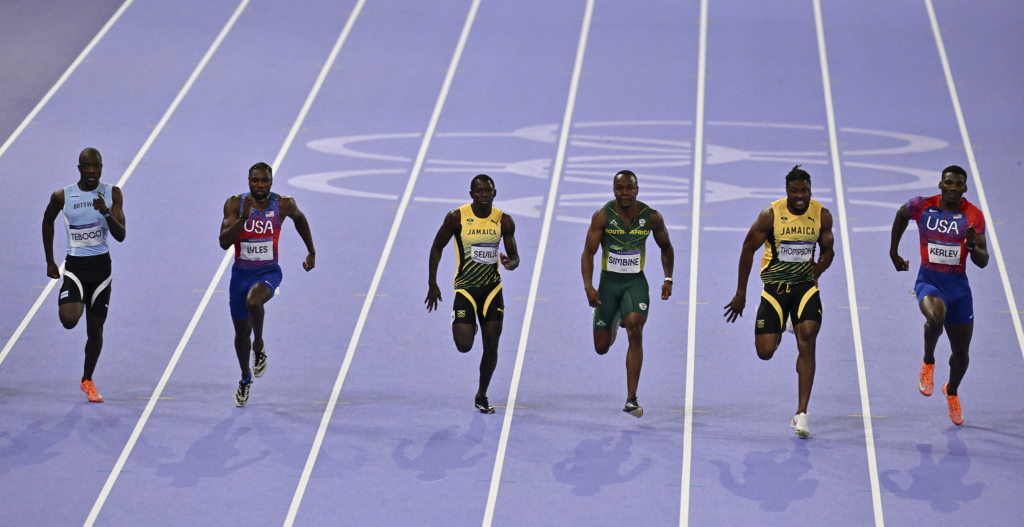
He had the slowest reaction of anyone in the field. At 60 meters and 70 meters he was still out of the medals.
“I just had to keep running like I was going to win it,” Lyles recalled. “Something told me,‘You need to lean.’ This is how close first and second is going to be.”
Follow us for more