Vice President Jagdeep Dhankhar has once again stirred the debate on judicial overreach, asserting that Parliament is the supreme law-making body in India. His comments have reignited conversations around the balance of power between the judiciary and the legislature.
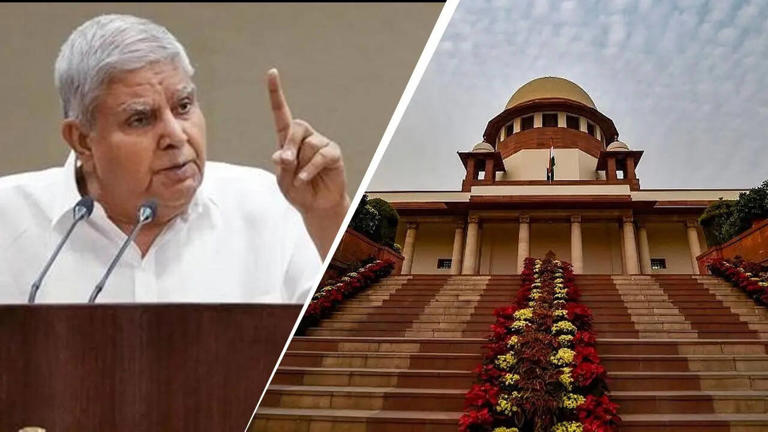
Vice President Jagdeep Dhankhar has again raised concerns about judicial overreach, making it clear that in a democratic setup like India’s, Parliament is supreme. His comments have sparked fresh discussions on the long-running debate between the powers of the judiciary and the legislature.
President Jagdeep Dhankhar made these remarks during a recent public address where he stressed that the Constitution of India clearly gives law-making authority to elected representatives. He questioned the idea of courts reviewing laws passed by Parliament, saying that doing so goes against the spirit of democracy.
This statement comes at a time when the tension between Parliament and the judiciary in India continues to be a sensitive topic. His views align with a growing number of voices who believe that the judiciary has sometimes crossed its limits by interfering in legislative matters.
What Did President Jagdeep Dhankhar Say?
President Jagdeep Dhankhar emphasized that:
“The Parliament is the ultimate authority in framing laws. The will of the people, expressed through their elected representatives, cannot be questioned by unelected bodies.”
He added that elected lawmakers, not judges, are answerable to the people of the country. If courts start reviewing every move of Parliament, it weakens the core of democracy, according to the Vice President.
This is not the first time Jagdeep President Jagdeep Dhankhar has spoken on the issue. In the past, too, he has raised concerns about the increasing interference of the judiciary in matters that, according to him, should be left to lawmakers.
What Is Judicial Overreach?
Judicial overreach is when the courts go beyond their powers and interfere in areas that are meant for the executive or the legislature. In India, the separation of powers is a key feature of the Constitution. Each branch of the government – the legislature, executive, and judiciary – has its own role.
Judicial activism, which is seen as positive when courts act to protect rights or hold the government accountable, can turn into overreach when courts begin to make or change laws, which is actually the job of Parliament.
Why Is This Debate Important?
The debate around Parliament vs Judiciary in India is not new. However, it has gained more attention in recent years due to several high-profile cases where the Supreme Court and High Courts have struck down laws or government decisions passed by Parliament.
While many citizens view these judgments as necessary checks on power, others, like President Jagdeep Dhankhar, argue that it amounts to judicial overreach, which can disturb the balance of power in India.
This balance is important to maintain a strong and fair democracy. If any one branch becomes too powerful, it can lead to problems like delays in justice, weak governance, or lack of accountability.
Reactions from the Legal and Political Community
President Jagdeep Dhankhar remarks have received mixed reactions. Supporters say that he is right in standing up for democratic values and reminding everyone of the authority of elected representatives. Critics, however, say that the courts have a duty to protect the Constitution and sometimes must strike down laws that violate fundamental rights.
Several legal experts have pointed out that while President Jagdeep Dhankhar statements stress a crucial point about democracy, the judiciary also plays a vital role in checks and balances.
A Constitutional Viewpoint
The Indian Constitution does not allow any one branch of government to dominate the others. Articles 121 to 147 deal with the powers and limitations of the judiciary, while Articles like 245 to 255 explain Parliament’s legislative powers.
The Supreme Court, in many past judgments, has defended its role by saying that reviewing laws for their constitutional validity is not interference, but part of its duty to protect the Constitution.
Moving Forward: Dialogue, Not Conflict
Instead of conflict, many experts suggest a dialogue between the judiciary and Parliament. Both institutions are pillars of democracy, and they must respect each other’s roles.
The goal should be a balanced partnership where courts ensure laws are fair and constitutional, and lawmakers ensure they create policies that reflect the people’s needs and are legally sound.
For more political insights and constitutional debates, check out our Politics and Governance section.
Conclusion
The judicial overreach debate 2025 continues to be a complex issue in India’s democracy. While Jagdeep President Jagdeep Dhankhar recent remarks have again brought attention to it, the answer lies not in choosing sides, but in finding a healthy balance of power.
For more updates stay connected with Notifire.in