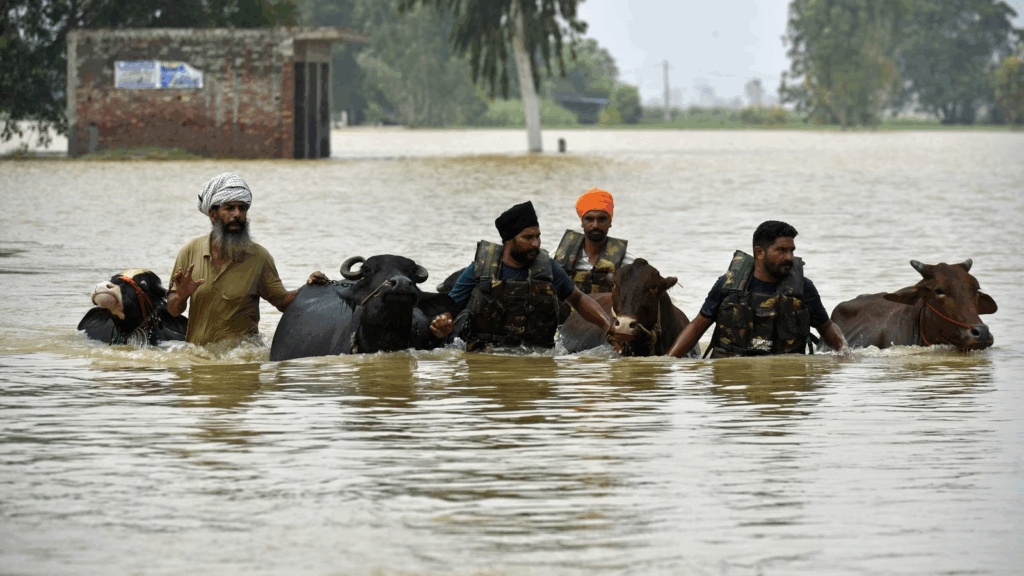
The Punjab Floods have caused widespread destruction across the state, killing at least 30 people and damaging more than 1,400 villages. These floods are part of the larger pattern of India Monsoon Floods, which continue to disrupt lives and affect millions every year. The situation highlights the urgent need for better planning, relief, and long-term flood management in India.
Overview of Punjab Flood Situation
Heavy rainfall during the monsoon has led to rivers overflowing in several districts of Punjab. According to official data, around 30 people have lost their lives and thousands have been displaced. More than 1,400 villages are reported to be damaged, with both homes and farmlands under water. The Punjab Floods have left many roads, schools, and health centers non-functional, making daily survival extremely difficult for local residents.
Impact on People, Villages, and Farms
The damage is not limited to infrastructure. Farmers, who form the backbone of Punjab’s economy, have seen large portions of their paddy and cotton crops submerged. This has led to concerns about food supply and financial losses for rural families. Villagers are struggling with loss of livestock, damaged houses, and scarcity of clean drinking water. For children and elderly, the health risks are rising due to waterborne diseases.
Government Rescue and Relief Efforts
The state and central governments have launched joint efforts to provide relief. The National Disaster Response Force (NDRF) and Army units are carrying out rescue operations in the worst-hit areas. Temporary shelters, food packets, and medical camps are being set up for flood victims. The government has also announced compensation for affected families and farmers, but the scale of loss suggests that much more assistance will be needed.
Challenges in Handling Rising Water
Despite these efforts, the Punjab Floods have shown how challenging it is to control monsoon disasters. Overflowing rivers, weak embankments, and poor drainage systems have worsened the crisis. In many areas, rescue teams are finding it hard to reach stranded people due to blocked roads and fast water currents. Lack of proper early warning systems has also been a major issue.
Steps to Control Future Flood Risks
Experts say the India Monsoon Floods are becoming more frequent due to climate change. To control future risks, Punjab needs stronger embankments, better river management, and modern flood forecasting systems. Urban planning should include proper drainage networks, while rural areas must be supported with crop insurance and disaster-resistant farming techniques.
Role of Local Communities in Support
Local communities are playing a big role in helping flood-hit families. Volunteers, NGOs, some Actors, famous personalities and farmer groups are distributing food, water, shelter and essential supplies. Many villagers are also providing shelter to neighbors who have lost homes. This spirit of unity has helped reduce immediate suffering, but long-term solutions must come from government action and planning.
Long-Term Solutions for Flood Safety
The Punjab Floods are a reminder that India needs a comprehensive national flood management policy. Investments in climate adaptation, strong disaster preparedness, and cooperation between states are crucial. Only then can lives and livelihoods be protected from recurring monsoon disasters.
Stay tuned with Notifire for more updates.