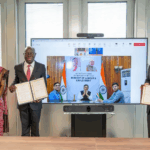
Shubhanshu Shukla ISS mission has marked a historic milestone in India’s space journey. As the first Indian to visit the International Space Station (ISS), Shukla’s 18-day space expedition under the Axiom-4 mission has not only brought pride to the nation but also advanced India space research 2025 goals. His contributions are seen as a strong support system to ISRO’s upcoming human spaceflight program—Gaganyaan.

Who Is Shubhanshu Shukla?
Shubhanshu Shukla is a Bengaluru-based engineer and aerospace researcher with strong ties to ISRO and academic institutions working in advanced space technology. Selected for the private Axiom‑4 mission, Shukla became a national figure as he represented India aboard the ISS. His selection underlines the growing international collaboration in space missions and India’s increasing influence in global space exploration.
About the Axiom‑4 Mission
The Axiom‑4 mission, a commercial venture by Axiom Space in collaboration with NASA and SpaceX, launched in early 2025. The mission aimed to foster private and international participation in microgravity research aboard the ISS. As highlighted by Hindustan Times, the SpaceX Dragon capsule carried Shukla and three other international astronauts to the ISS for a focused 18-day scientific stay.
18 Days Conducting 60+ Experiments
During the mission, Shubhanshu Shukla and his crew conducted over 60 experiments related to space medicine, robotics, life sciences, and advanced materials. These experiments aimed to enhance understanding of human adaptation to space and how various technologies perform in microgravity. Many of these experiments were led by ISRO, reinforcing India’s growing role in advanced space research.
Key ISRO‑Led Microgravity Studies
A major part of the Shubhanshu Shukla ISS mission involved microgravity research coordinated with ISRO scientists. These included studying muscle loss in space, bio-cell behavior, and fluid dynamics in zero gravity. According to The Hindu, the findings are expected to be directly integrated into planning and improving India’s Gaganyaan crew modules and astronaut health protocols.
Mission Aims: Support Gaganyaan Program
One of the key objectives of the Shubhanshu Shukla ISS mission was to test technologies and collect human performance data that could help ISRO’s upcoming Gaganyaan mission. His role as a payload specialist allowed India to test its own instruments aboard the ISS, a rare and valuable opportunity in India’s manned spaceflight ambitions.
Return & Recovery Back on Earth
On completion of the mission, the crew aboard SpaceX’s Dragon spacecraft successfully splashed down in the Atlantic Ocean. As per Hindustan Times, Shubhanshu Shukla was “all smiles” after the safe return, reflecting both pride and accomplishment. His recovery marks a crucial learning curve for post-mission recovery operations for India.
What This Means for India’s Space Future
The Shubhanshu Shukla ISS mission is more than a personal achievement—it represents India’s leap into the elite group of nations capable of manned space research. It validates the growing collaboration between India and global space platforms like Axiom and NASA. With the India space research 2025 roadmap gaining momentum, this mission strengthens ISRO’s technical base and global partnerships.
Shukla’s journey will inspire future generations and accelerate the timeline for India’s independent space station and beyond. With ISRO’s dedication and increasing international participation, India is undoubtedly on track to becoming a global space powerhouse.
Stay Tuned with Notifire: Your Spark for Every Update.