A Classic Game Rebuilt for New Raspberry Pi Pico
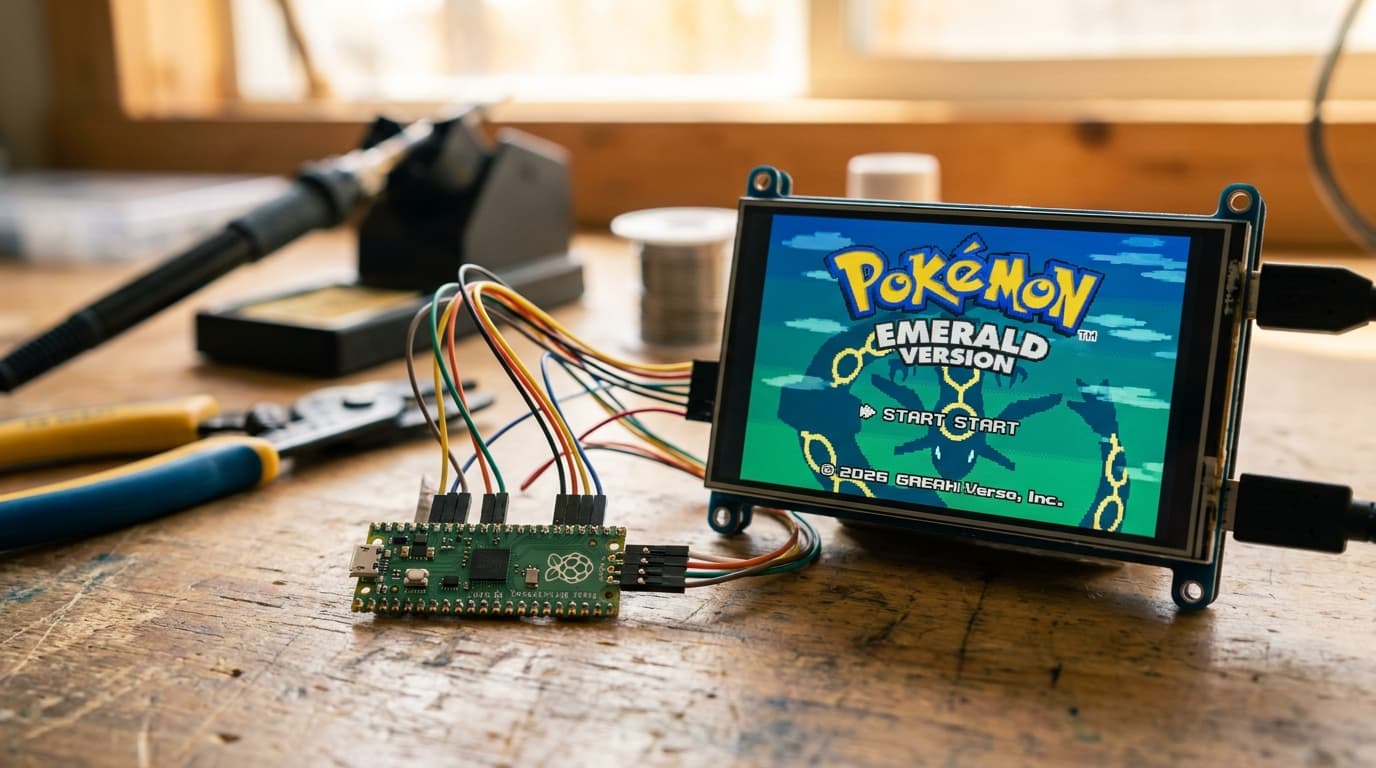
TL;DR: A developer has successfully ported Pokémon Emerald to the new Raspberry Pi Pico 2. The game was recompiled to run natively without an emulator, showcasing the impressive power of the tiny RP2350 microcontroller for complex software projects.
Key facts
- Category
- Tech Updates
- Impact
- High
- Published
- Source
- Hacker News
Full summary
A developer recompiled Pokémon Emerald to run natively on the new Raspberry Pi Pico 2, achieving 60 fps without using an emulator.
A developer has achieved a significant milestone in embedded systems by porting the classic video game Pokémon Emerald to the new Raspberry Pi Pico 2. As highlighted on Hacker News, the project is not an emulator, which would simply simulate the original hardware. Instead, the game runs natively on the Pico’s RP2350 microcontroller, delivering a smooth 60 frames per second directly to an HDMI display. This accomplishment goes far beyond a simple hobby project, serving as a powerful demonstration of the capabilities of modern, low-cost microcontrollers. It represents a fundamental re-engineering of a commercial game to operate on a completely different and much more constrained hardware platform than the one for which it was originally designed, pushing the boundaries of what was thought possible on such a small device.
The technical process behind this port is what makes it so impressive. The developer recompiled the game's code from its original ARMv4T instruction set, used in the Game Boy Advance, to the Cortex-M33 architecture of the Raspberry Pi Pico 2. This translation is a complex task that requires a deep understanding of both processor architectures. Furthermore, the Game Boy Advance relied on specialized, dedicated hardware chips to generate its video output. The Pico has no such hardware. To overcome this, the developer reimplemented the entire video system in software, dedicating the second core of the RP2350 chip to the single task of generating a real-time video signal. This software-based video rendering is a computationally intensive process that highlights the raw processing power and dual-core flexibility of the new chip.
For developers, CTOs, and engineering teams, this project is a clear signal that the performance ceiling for microcontrollers has been raised considerably. These small, power-efficient chips are no longer relegated to simple tasks like blinking lights or reading sensor data. This port proves they can handle complex, real-time applications that include sophisticated logic and graphical output. It challenges engineers to reconsider their hardware choices for new products. A task that might have previously required a more expensive single-board computer running a full Linux operating system, like a standard Raspberry Pi, might now be achievable on a cheaper, more efficient microcontroller. This opens up new possibilities for creating more advanced user interfaces and on-device processing in embedded systems.
The business implications are rooted in cost reduction and innovation. The Raspberry Pi Pico 2 is an inexpensive component, and its ability to handle demanding workloads can significantly lower the bill of materials for new electronic products. Companies in sectors like IoT, industrial automation, and consumer electronics can now explore building more feature-rich devices without a corresponding increase in hardware cost or power consumption. This project acts as a public benchmark, validating the RP2350 as a viable platform for ambitious projects. The practical takeaway for business leaders and product managers is to encourage their technical teams to evaluate these next-generation microcontrollers, as they may unlock new product categories or make existing ones more profitable.
Looking ahead, this achievement will likely inspire a wave of similar projects within the maker and developer communities. As more people experiment with the limits of the Raspberry Pi Pico 2, a richer ecosystem of open-source libraries and tools for graphics, audio, and advanced computation will emerge. This community-driven development will make it easier for everyone, from hobbyists to commercial enterprises, to build sophisticated applications on the platform. For the Raspberry Pi Foundation, this project is a powerful marketing tool that demonstrates the real-world performance of its new silicon in a way that technical specifications alone cannot, solidifying its role as a leader in accessible, high-performance computing hardware.
Why it matters
This project demonstrates a significant leap in the performance and capability of low-cost microcontrollers. It proves that devices like the Raspberry Pi Pico 2 can now handle complex, real-time tasks previously reserved for more powerful and expensive computers, opening up new possibilities for developers in embedded systems.
Business impact
Companies can now consider using cheaper, more power-efficient microcontrollers for products that require sophisticated graphics or computation. This can lower manufacturing costs for IoT devices, consumer electronics, and industrial controls, potentially creating more competitive and innovative products.
Tags
Related on Notifire
Related stories
Primary source: Hacker News