The Army's New Anti-Drone Laser Costs $5 a Shot
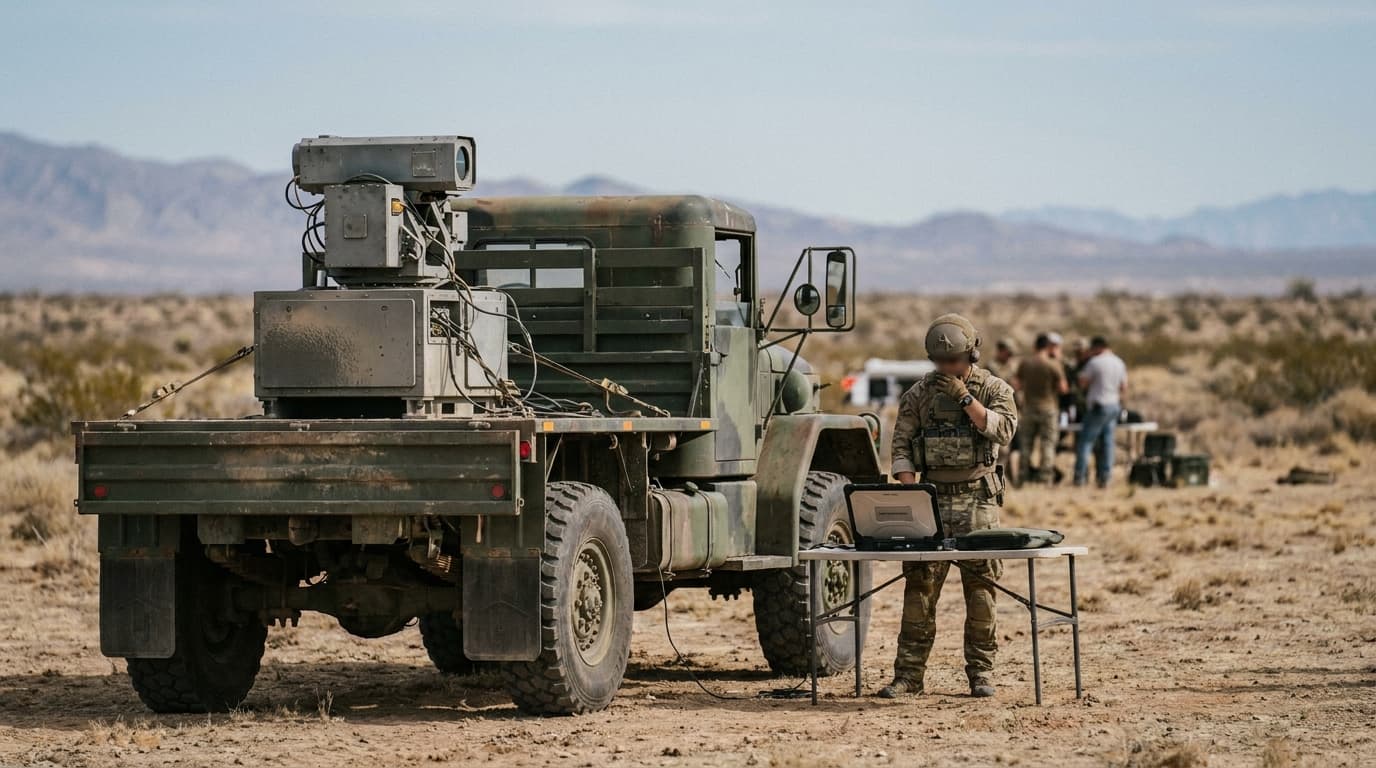
TL;DR: The US Army is developing a modular laser weapon that fits onto standard military trucks. This system, called LOCUST X3, can destroy drones for as little as $5 per shot, offering a highly cost-effective defense against a growing threat.
Key facts
- Category
- Tech Updates
- Impact
- High
- Published
- Source
- TechRadar
Full summary
The US Army is adopting a new modular laser system that turns standard military trucks into cost-effective anti-drone weapons.
The US Army is fundamentally changing its approach to high-energy laser weapons, moving away from specialized, single-purpose vehicles. According to a report from TechRadar, the military is now focused on modular systems that can be mounted on its existing fleet of standard trucks. Aerospace and defense company AeroVironment has won an initial contract to develop a 30-kilowatt system called the LOCUST X3. This new strategy aims to create a flexible and highly mobile defense network capable of countering the growing threat of small, unmanned aerial systems, commonly known as drones. By equipping ordinary vehicles with these advanced weapons, the Army can rapidly deploy anti-drone capabilities wherever they are needed, without having to field an entirely new and expensive class of dedicated laser trucks.
The key innovation behind the LOCUST X3 is its modular, vehicle-agnostic design. Unlike previous generations of directed-energy weapons that were deeply integrated into a specific vehicle's chassis and power systems, this new system is designed as a self-contained 'plug-and-play' unit. This means the entire laser module, including its power source and targeting systems, can be quickly attached to or detached from any suitable military truck. This decoupling offers a significant operational advantage. If a vehicle carrying the laser is damaged or requires routine maintenance, the weapon system is not taken out of service along with it. Instead, it can be swiftly transferred to another operational truck, maximizing its availability and ensuring continuous defensive coverage.
This shift is part of a broader trend in both military and commercial technology toward disaggregation and cost-effective solutions to asymmetric threats. The proliferation of inexpensive, commercially available drones has created a significant challenge for conventional air defense systems. Using a traditional missile, which can cost hundreds of thousands or even millions of dollars, to destroy a drone that costs a few hundred dollars is economically unsustainable. The LOCUST X3 directly addresses this economic imbalance. With an estimated cost of just $5 to $10 per shot, it provides a financially viable way to counter swarms of cheap drones. This mirrors the evolution in cybersecurity, where scalable, low-cost defensive tools are needed to fend off a high volume of low-sophistication attacks. The principle is the same: the cost of defense must be proportionate to the cost of the threat.
For founders, CTOs, and security leaders, this development serves as a powerful case study in hardware innovation and strategic cost management. It demonstrates how breaking down monolithic systems into flexible, interchangeable modules can dramatically increase efficiency and reduce long-term operational costs. The technology's potential extends far beyond the battlefield. As drone use becomes more widespread, the need for effective and affordable countermeasures for civilian infrastructure—such as airports, power plants, and large public venues—will grow. The success of modular laser systems in the military could accelerate the development of similar commercial products for physical security. The next phase to watch will be the system's performance in field tests and how quickly this modular design philosophy is applied to other classes of advanced hardware, from robotics to remote sensing equipment.
Why it matters
This shift to modular, vehicle-agnostic hardware reflects a major trend in defense and robotics. It shows how complex systems are becoming more flexible and cost-effective, a lesson applicable to enterprise hardware development, physical security systems, and IoT deployments where adaptability is key.
Business impact
The extremely low cost-per-shot ($5-$10) completely changes the economics of drone defense. This creates new market opportunities for companies developing low-cost physical security solutions and disrupts the market for traditional, expensive anti-air systems for both defense and corporate security.
Tags
Related on Notifire
Related stories
Primary source: TechRadar