Drones Now Fly Into Storms for Better Forecasts
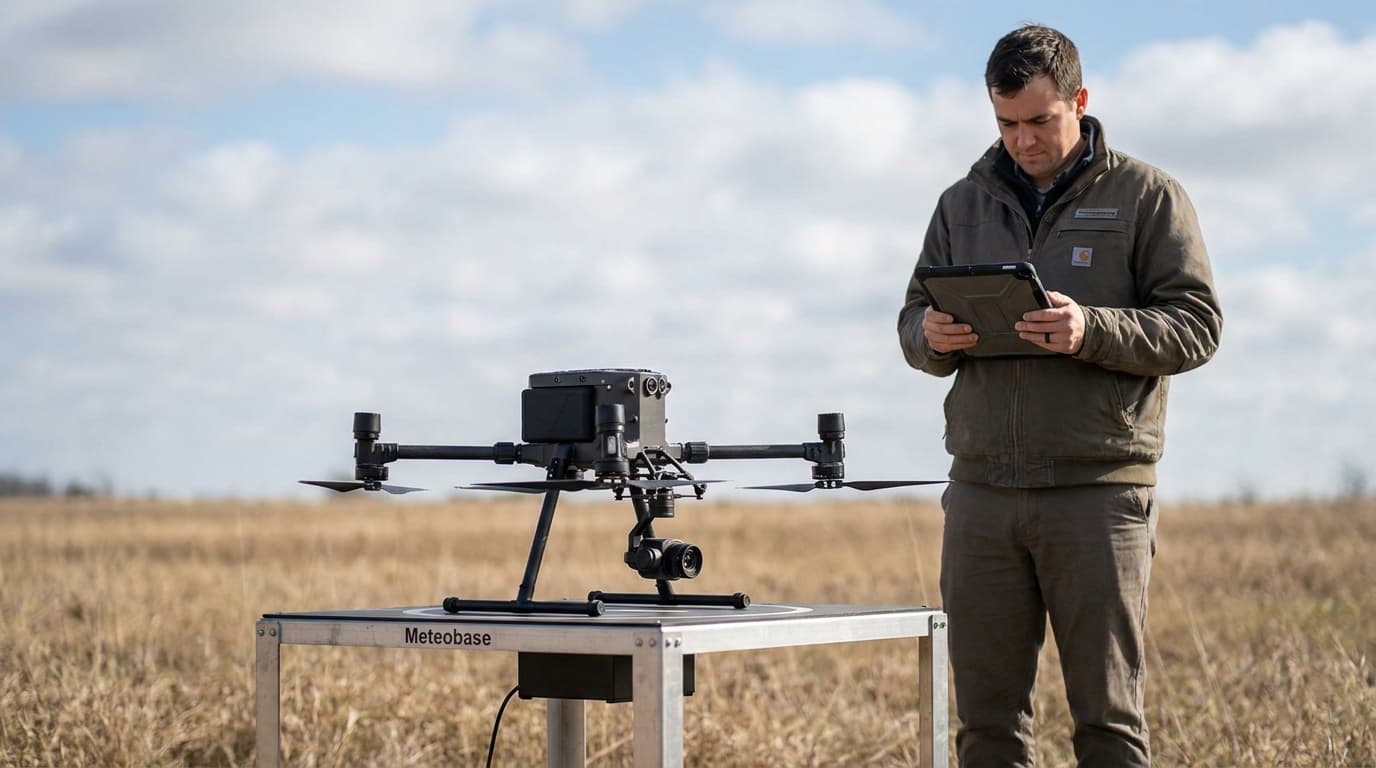
TL;DR: A new system uses automated drones to collect atmospheric data, offering a more precise and reusable alternative to traditional weather balloons. This could significantly improve hyperlocal weather forecasting for sensitive industries.
Key facts
- Category
- Tech Updates
- Impact
- Medium
- Published
- Source
- Slashdot
Full summary
Automated drones are now collecting atmospheric data, offering a reusable and more precise alternative to traditional weather balloons for forecasting.
U.S. company Meteomatics has developed an automated system that uses drones to gather atmospheric data, offering a modern alternative to traditional weather balloons. According to reporting from Slashdot, the system, called a Meteobase, consists of a weather-resistant ground station that automatically launches, recovers, and recharges a drone. These drones fly to various altitudes to collect detailed information about temperature, humidity, and wind conditions before returning to the base to upload their findings. This approach allows for repeated, targeted data collection in the lower atmosphere, an area critical for weather formation but often under-sampled by conventional methods. The goal is to provide a continuous stream of high-resolution data that can feed into and improve the accuracy of weather prediction models.
The core innovation lies in the system's autonomy and resilience. The Meteobase is designed to operate in harsh conditions, protecting the drone and enabling launches even during inclement weather. Unlike a weather balloon, which makes a single, one-way trip and is often unrecoverable, the drone is a reusable asset that can be dispatched on demand. It can also be programmed to hover at specific altitudes of interest, gathering more comprehensive data from a particular atmospheric layer. This capability is a significant technical leap, transforming weather data collection from a periodic, generalized process into a targeted, on-demand service. The system effectively combines robotics, IoT connectivity, and meteorology to create a persistent monitoring platform that can be deployed in remote or critical locations.
For founders, CTOs, and developers, this technology represents a new frontier in environmental data. Industries whose operations are highly sensitive to weather—such as aviation, logistics, agriculture, and energy—stand to benefit significantly. Current weather models often provide regional forecasts that may not capture critical microclimates or rapidly developing local conditions. Access to hyperlocal, real-time atmospheric data allows for more precise operational planning. For example, an airline could get better data on low-altitude wind shear near an airport, a shipping company could reroute vehicles around a developing hailstorm, and a farm could optimize irrigation based on precise, on-site humidity readings. This moves decision-making from being based on broad predictions to being informed by immediate, localized intelligence.
The business and industry impact is a potential shift from a disposable data collection model to a more sustainable and efficient one. While weather balloons are relatively inexpensive for a single launch, their cumulative cost and environmental waste are considerable. An automated drone system, though requiring a higher initial investment, offers a lower cost per data point over its lifespan and provides superior, more actionable information. This opens the door for new business models centered around hyperlocal weather data as a service. For technical teams, this means the emergence of new, rich data streams and APIs that can be integrated into logistics platforms, agricultural management software, and risk analysis models. The practical takeaway is to view atmospheric conditions as another high-resolution IoT data source that can be leveraged for competitive advantage and operational efficiency.
Looking ahead, the primary challenges for widespread adoption will involve regulation, scalability, and data integration. Gaining approval for autonomous drone flights, particularly beyond the visual line of sight and in controlled airspace, remains a significant hurdle. To provide comprehensive coverage, a large network of these Meteobases would need to be deployed, requiring substantial infrastructure investment. Furthermore, the data generated by these systems must be seamlessly integrated into existing global weather models to enhance their predictive power. The success of this technology will hinge on proving its reliability, cost-effectiveness, and ability to deliver demonstrably better forecasting outcomes compared to the centuries-old method of releasing balloons into the sky.
Why it matters
This technology provides highly localized, real-time atmospheric data, a significant improvement over traditional weather balloons. It enables industries like aviation, logistics, and agriculture to make more precise, data-driven operational decisions based on actual microclimate conditions.
Business impact
The shift from single-use weather balloons to reusable, autonomous drones creates a new "data-as-a-service" model for meteorology. This could lower long-term data collection costs and open up new markets for hyperlocal forecasting services and APIs.
Tags
Related on Notifire
Related stories
Primary source: Slashdot