Drones Now Land on Moving Ships Using Cameras
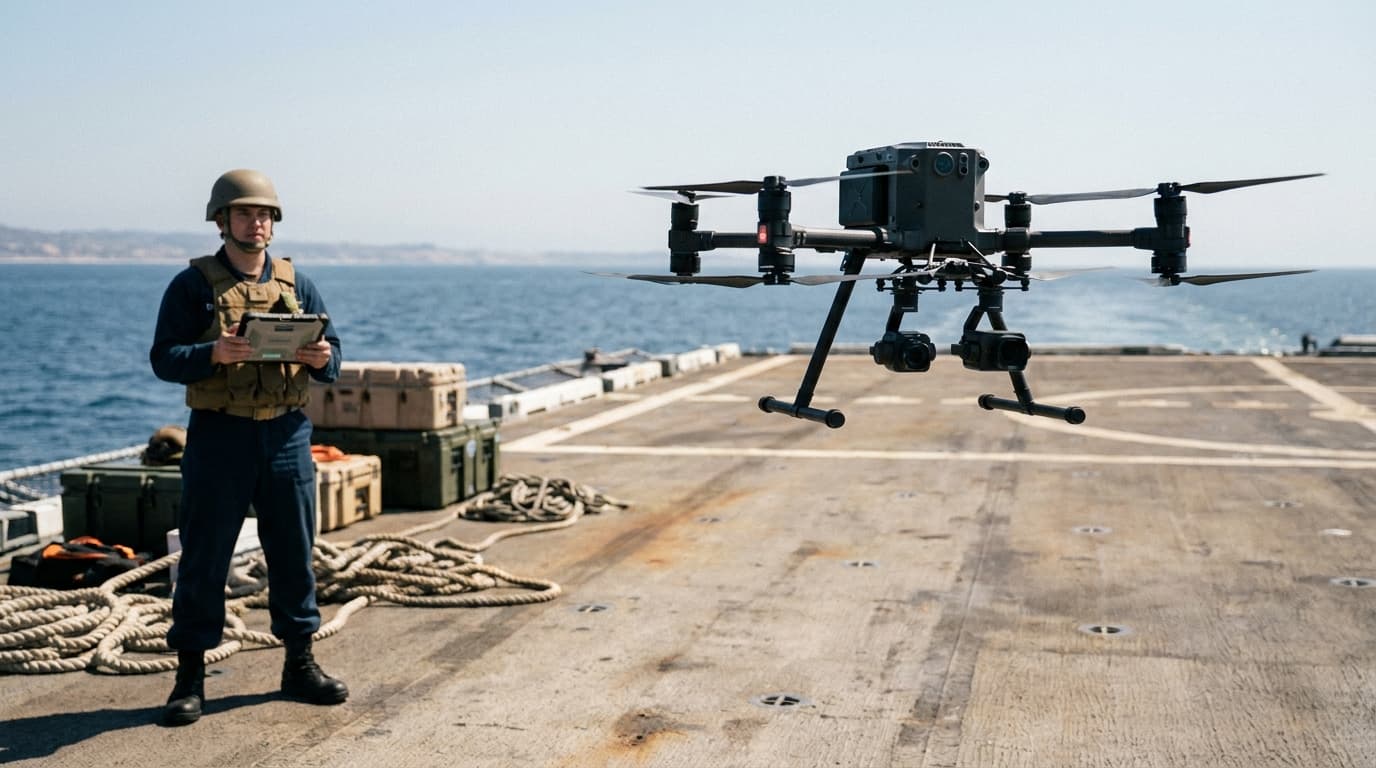
TL;DR: The US Navy tested software that lets drones land on moving ships using only their onboard cameras. This provides a crucial backup for autonomous systems when GPS signals are jammed or unavailable, a common military threat.
Key facts
- Category
- Tech Updates
- Impact
- High
- Published
- Source
- TechRadar
Full summary
The US Navy is testing new software that allows autonomous drones to land on moving ships using only their onboard cameras.
The U.S. Navy has successfully tested new software that allows autonomous drones to land on moving ships without relying on GPS. This system uses only the drone's onboard cameras to navigate, marking a significant advancement for autonomous operations in contested environments. The ability to function without satellite navigation is critical, as GPS signals are often the first target for jamming or disruption in a conflict. This test demonstrates a practical solution to a long-standing vulnerability for military and commercial autonomous systems, proving that drones can complete complex missions even when their primary navigation link is severed. The software also reduces the need for expensive, specialized tracking equipment typically installed on naval vessels to guide incoming aircraft.
The technology works by employing sophisticated computer vision algorithms. The drone's onboard camera captures a live video feed of its surroundings, which is processed in real time by an onboard computer. The software identifies the ship and the designated landing pad, treating it as a visual target. By continuously analyzing the target's size, shape, and position in the camera's frame, the system calculates the drone's precise location, altitude, and velocity relative to the moving vessel. It then generates flight control commands to adjust the drone's trajectory, compensating for the ship's pitch, roll, and forward movement. This creates a closed-loop guidance system that is entirely self-contained within the drone, making it immune to external signal interference.
This achievement fits into a broader industry trend focused on solving the challenge of GPS-denied navigation. For decades, over-reliance on the Global Positioning System has been a well-known single point of failure for critical infrastructure, logistics, and defense. While other solutions like inertial navigation systems (INS) exist, they suffer from "drift," where small errors accumulate over time, reducing accuracy. Vision-based navigation, however, offers a passive and increasingly affordable alternative. This U.S. Navy test is a powerful proof-of-concept, validating the technology in a highly dynamic and unforgiving maritime environment. It moves computer vision from a supplementary sensor to a primary navigation tool capable of handling mission-critical tasks that demand high precision.
For technology leaders and developers, this test serves as a clear indicator that vision-based navigation is ready for prime time. It highlights the importance of building resilience and redundancy into any autonomous system, especially those intended for commercial or industrial use where signal loss is a real possibility. Companies in logistics, agriculture, and infrastructure inspection should now consider visual navigation not just as a backup but as a core component of their robotic platforms. Looking ahead, the next phase of development will likely focus on enhancing the system's robustness in adverse weather, low-light conditions, and more complex sea states. We can also expect to see these capabilities integrated into a wider array of autonomous vehicles, both in the air and on the ground.
Why it matters
This demonstrates a major step forward for computer vision in real-world, high-stakes navigation. For developers in robotics and autonomous systems, it validates vision-based navigation as a primary method for operating in GPS-denied environments, moving it from theory to proven application in dynamic conditions.
Business impact
Companies developing autonomous vehicles, drones, or logistics robots now face a higher standard for operational resilience. This technology creates a competitive advantage for defense contractors and a new requirement for commercial systems operating in potentially insecure areas, reducing reliance on expensive tracking hardware.
Tags
Related on Notifire
Related stories
Primary source: TechRadar