Humanoid Robots Are Now Ready for Warehouse Jobs
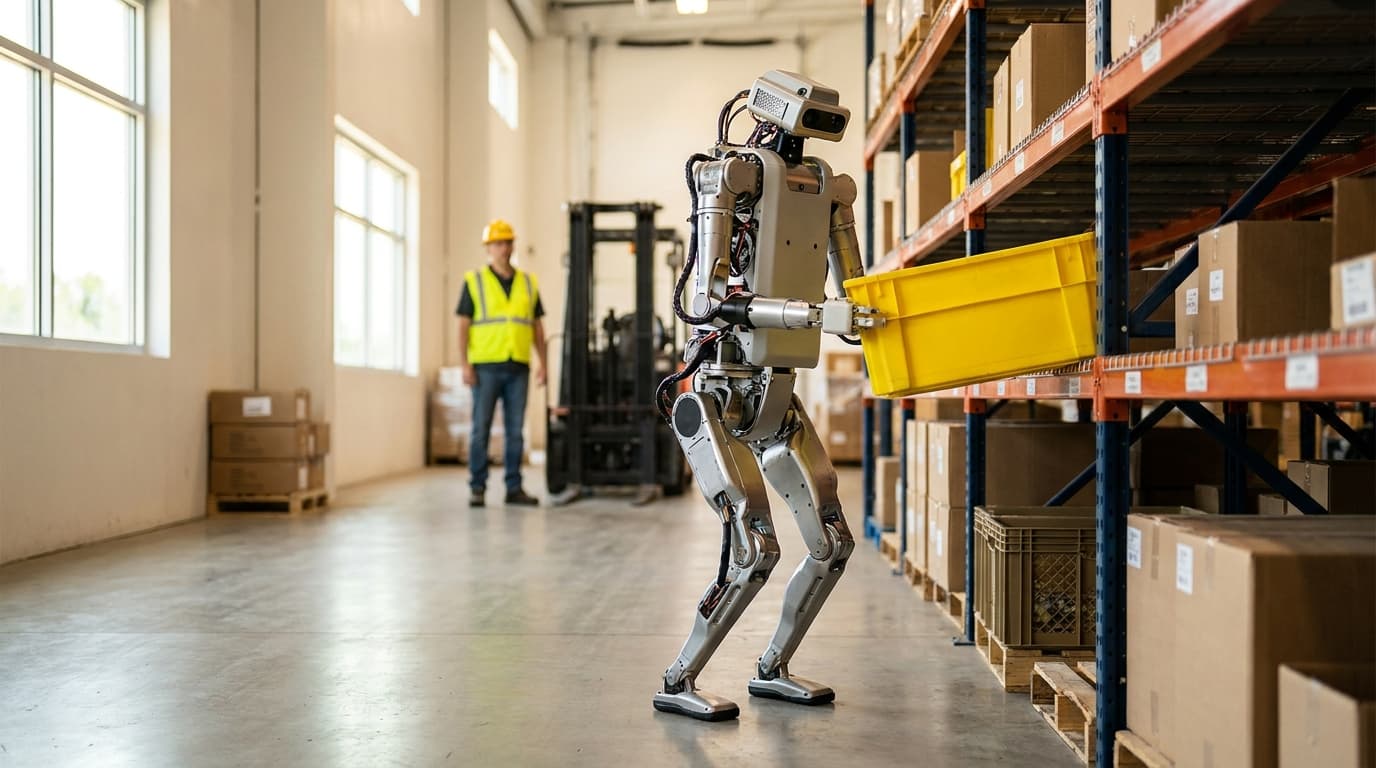
TL;DR: Agility Robotics has launched Digit 5, a humanoid robot designed for mass deployment in warehouses. The robot can lift 23kg bins, aiming to bring tens of thousands of automated workers into the logistics industry.
Key facts
- Category
- Tech Updates
- Impact
- High
- Published
- Source
- IEEE Spectrum
Full summary
Agility Robotics just launched Digit 5, a humanoid robot designed to work at scale in warehouses and logistics centers alongside people.
Agility Robotics has officially launched its new Digit 5 humanoid robot, a machine designed specifically for large-scale commercial deployment. According to a report in IEEE Spectrum, the company, which spun out of Oregon State University, aims for Digit to be the first humanoid robot that can perform useful work safely and economically in real-world environments like warehouses. The primary goal is ambitious: to deploy tens of thousands of these robots as a new class of worker. The Digit 5 is engineered for practical logistics tasks, such as lifting 23-kilogram (50-pound) bins and placing them on high shelves. Its design prioritizes functionality within existing human-centric infrastructure, signaling a significant shift from research prototypes to commercially viable products ready for the workforce.
What makes the Digit 5 humanoid robot a notable advancement is its focus on commercial readiness rather than pure technical demonstration. The key innovation lies in the integration of mobility, manipulation, and endurance into a single, economically viable platform. Its bipedal, human-like form allows it to navigate spaces designed for people, such as stairs and narrow aisles, eliminating the need for costly facility retrofits that other automation solutions often require. The robot's arms and manipulators are specifically built for common warehouse objects like totes and bins. Furthermore, its power system is designed to support long operational periods, a critical requirement for any machine intended to work full shifts. This combination of practical design choices shows a deep understanding of the target market's needs, prioritizing reliability and utility over flashy but impractical capabilities.
The launch of Digit 5 places Agility Robotics in a competitive but rapidly evolving landscape. While Boston Dynamics' Atlas robot is famous for its acrobatic feats, it has primarily served as a research platform. Similarly, Tesla's Optimus project has generated significant buzz but remains largely in the development and demonstration phase. Agility’s strategy appears to be more focused and immediate: target a specific, high-demand vertical—logistics and warehousing—where labor shortages are acute and the environment is semi-structured. This pragmatic approach may allow Digit to achieve commercial scale faster than its more generalized competitors. The development reflects a broader industry trend where advances in AI, particularly in computer vision and reinforcement learning, are finally making it possible for robots to operate effectively outside of highly controlled factory settings.
For business leaders, CTOs, and developers, the arrival of Digit 5 is a clear indicator that humanoid robotics is transitioning from science fiction to a practical business tool. The immediate implication is for the logistics and supply chain industries, which can now begin to seriously evaluate humanoid robots as a flexible solution to labor challenges and operational inefficiencies. Unlike fixed automation, a fleet of Digit robots could be dynamically reassigned to different tasks, offering a level of adaptability previously unseen. The next critical steps to watch will be the results of pilot programs with major logistics partners, details on pricing and maintenance models, and real-world data on the robot's performance, safety, and uptime. As this technology matures, it will force a reevaluation of the relationship between human labor and automation in a wide range of industries.
Why it matters
Digit 5 represents a major step toward commercially viable humanoid robots in unstructured environments. For developers and engineers, it signals that the complex challenges of bipedal locomotion, manipulation, and safe human-robot interaction are becoming solvable for real-world industrial applications, moving beyond research labs.
Business impact
The deployment of humanoid robots like Digit 5 could fundamentally change warehouse and logistics operations, addressing labor shortages and boosting efficiency. For businesses, this technology presents a new, flexible automation solution that can integrate into existing human-centric workflows without requiring complete infrastructure overhauls.
Tags
Related on Notifire
Related stories
Primary source: IEEE Spectrum