A New Laptop Uses Its SSD as Extra AI Memory
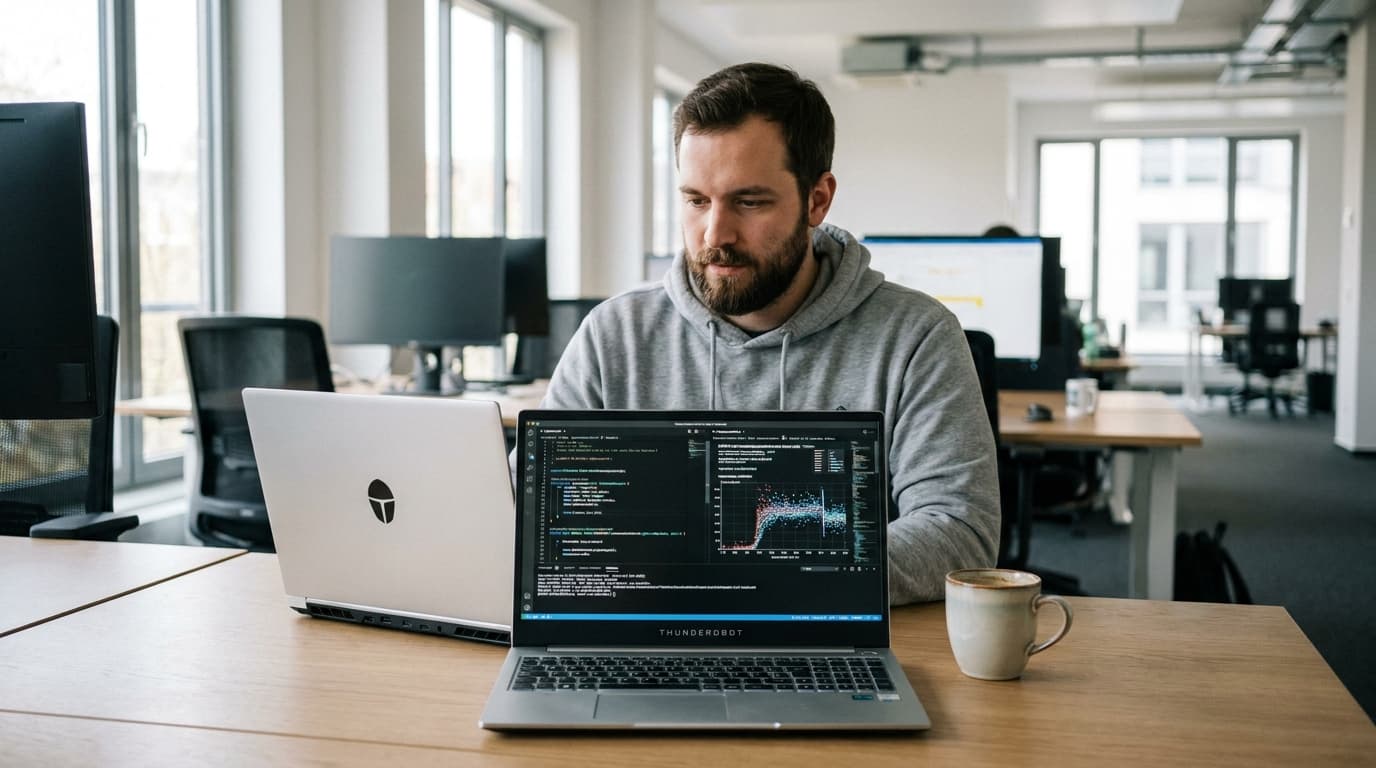
TL;DR: A new laptop uses its SSD as an AI cache, allowing it to run 120-billion-parameter models with just 64GB of RAM. This technique could make powerful local AI development more accessible and affordable for developers.
Key facts
- Category
- AI
- Impact
- High
- Published
- Source
- TechRadar
Full summary
A new laptop uses its SSD as an AI memory cache, enabling it to run 120-billion-parameter models with just 64GB of RAM.
Chinese hardware manufacturer Thunderobot has unveiled a new mobile workstation that tackles one of the biggest challenges in local AI development: memory limitations. According to reporting from TechRadar, the new AI Master M7000 laptop can run a massive 120-billion-parameter AI model despite being equipped with only 64GB of system RAM. This feat, which would typically require specialized hardware with far more memory, is made possible by a novel approach that leverages the device's solid-state drive (SSD). The laptop is built around AMD's latest Ryzen AI Max+ 395 processor and features 64GB of fast LPDDR5X memory, positioning it as a powerful machine for developers and researchers who want to run complex AI tasks without relying on the cloud. The ability to handle such a large model on a portable device represents a significant step forward in making advanced AI more accessible.
The technology enabling this capability is a solution from storage controller maker Phison called aiDAPTIV+. It works by intelligently using a portion of the laptop's fast NVMe SSD as an extension of the system's main memory, creating a dedicated cache for AI workloads. Large language models are defined by their parameters, which are essentially the learned values the model uses to make predictions. A model with 120 billion parameters requires a vast amount of memory just to load these values. When a system's RAM is insufficient, the model cannot be loaded, and the application fails. Phison's technology circumvents this by offloading parts of the model that are not immediately needed from the RAM to the SSD. It then intelligently swaps the necessary data back and forth as the model processes information. While an SSD is slower than RAM, modern NVMe drives are fast enough to make this process viable for many inference tasks, effectively expanding the system's usable memory for AI.
This approach of using storage to augment system memory is part of a broader industry trend aimed at breaking the dependency on ever-larger and more expensive RAM and VRAM configurations. Apple's Unified Memory Architecture in its M-series silicon is a well-known example, allowing Macs to efficiently share a single pool of memory between the CPU and GPU and spill over to the SSD, enabling them to run surprisingly large AI models. The introduction of Phison's aiDAPTIV+ in a Windows laptop based on AMD hardware shows this concept is gaining traction across the ecosystem. It signals a strategic shift toward on-device AI, where processing happens locally for improved privacy, lower latency, and reduced operational costs. As AI models become more integrated into everyday applications, hardware solutions that can run them efficiently without constant cloud connectivity will become increasingly critical for both consumer and enterprise devices.
For developers, CTOs, and IT teams, the Thunderobot M7000 and the underlying Phison technology are a clear indicator of the future of AI-capable hardware. The key takeaway is that evaluating a machine for AI work is no longer just about counting gigabytes of RAM or measuring GPU core counts. The speed and intelligence of the storage subsystem are now crucial factors. This development could significantly lower the barrier to entry for developers wanting to experiment with or fine-tune large models locally. The next step will be to see real-world performance benchmarks. While the system can run a 120B model, the inference speed—how quickly it generates a response—will determine its practical utility. We should also watch for wider adoption of this technology by other major laptop manufacturers, as it could create a new class of affordable, AI-focused workstations and reshape the competitive landscape for PC hardware.
Why it matters
This approach challenges the idea that running 100B+ parameter models requires massive amounts of expensive VRAM or system RAM. It could enable more developers to experiment with and fine-tune large models locally on a single machine, accelerating innovation and reducing reliance on cloud infrastructure.
Business impact
This technology could lower the total cost of ownership for AI development workstations, reducing the need for expensive cloud compute for certain tasks. It creates a new competitive front for PC makers, shifting focus from raw RAM capacity to intelligent storage solutions for AI workloads.
Tags
Related on Notifire
Related stories
Primary source: TechRadar