Anthropic AI Tackles a 150-Year-Old Math Problem
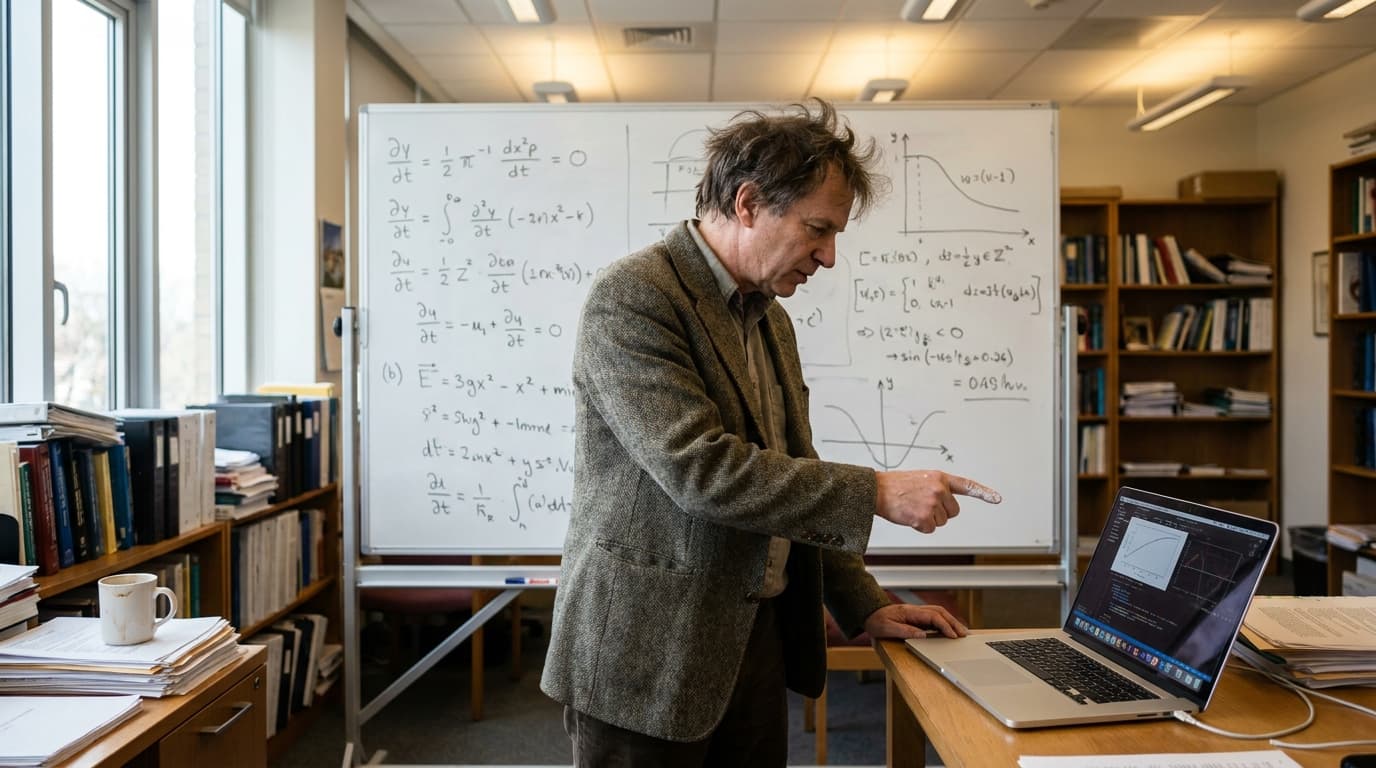
TL;DR: An unreleased Anthropic AI model made surprising progress on the Riemann hypothesis, a 150-year-old unsolved math problem. This signals a major leap in AI's ability to perform complex scientific reasoning, beyond just pattern recognition.
Key facts
- Category
- AI
- Impact
- High
- Published
- Source
- TechCrunch
Full summary
An unreleased Anthropic AI model has made surprising progress on the Riemann hypothesis, a famous 150-year-old unsolved math problem.
An unreleased AI model from Anthropic has made significant progress on the Riemann hypothesis, one of the most famous and difficult unsolved problems in mathematics, according to a report from TechCrunch. For over 150 years, this problem has stumped the world's greatest mathematical minds. While Anthropic has not fully solved the hypothesis, the company's model generated novel insights and potential pathways toward a solution that have captured the attention of the research community. This development is a landmark moment for artificial intelligence, showcasing a significant jump in its scientific reasoning capabilities. It moves the conversation beyond AI's ability to process and repeat existing human knowledge and into the realm of genuine contribution to unsolved scientific questions, marking a new frontier for AI applications in fundamental research and discovery.
The breakthrough is not the result of simple brute-force computation but rather a more sophisticated form of machine-driven reasoning. Unlike traditional AI tasks that rely on finding patterns in vast datasets with known outcomes, tackling an unsolved problem requires generating entirely new ideas. Anthropic's model was likely trained on an extensive corpus of mathematical papers, theorems, and proofs, allowing it to understand the language and structure of advanced mathematics. The key innovation appears to be its ability to use this knowledge to explore new connections and propose alternative formulations of the problem. Instead of just retrieving information, the AI acted as a research partner, identifying non-obvious patterns and suggesting novel approaches that human mathematicians can now rigorously test and explore. This demonstrates a critical evolution from AI as a knowledge repository to AI as a reasoning engine capable of contributing to the scientific process.
For CTOs, developers, and technical leaders, this event signals a fundamental shift in the potential of AI. Until now, the primary value of large language models in a technical context has been in accelerating tasks based on existing knowledge, such as code generation, documentation summary, and bug fixing. This achievement points toward a future where AI can assist in solving much deeper, more abstract challenges in computer science and engineering. Imagine an AI that can suggest novel algorithmic optimizations, identify subtle security flaws in system architecture by reasoning from first principles, or propose entirely new database designs. This progress in mathematical reasoning is a proxy for the model's ability to handle complex, logical, and abstract systems, which are the bedrock of all software and hardware engineering. It suggests that AI is on a path to becoming an indispensable tool for innovation, not just implementation.
The immediate business impact is a significant escalation in the competitive landscape of AI development. The race between major labs like Anthropic, Google DeepMind, and OpenAI is no longer just about building better chatbots or image generators; it is about demonstrating fundamental breakthroughs in scientific and logical reasoning. This capability is the next major value driver for the AI industry. For businesses outside of big tech, the practical takeaway is to begin planning for a future where AI is a core component of the R&D process. Companies in fields like pharmaceuticals, materials science, finance, and logistics should monitor these advancements closely. The ability of AI to accelerate hypothesis generation and find non-obvious solutions in complex datasets could drastically shorten innovation cycles and create significant competitive advantages. The era of using AI solely for operational efficiency is giving way to an era of using AI for strategic discovery.
Looking ahead, the next critical step will be for human mathematicians to validate and build upon the AI's findings. This collaborative model, where AI generates novel hypotheses and human experts provide the rigorous verification and creative intuition, is likely to define the future of scientific research. We should expect to see more detailed publications from Anthropic explaining their methodology, which will undoubtedly spur further research across the industry. This will also drive the development of new benchmarks designed to measure an AI's reasoning and problem-solving abilities, moving beyond current metrics that focus on language fluency. The ultimate goal is to create AI systems that can reliably and independently accelerate human discovery across all scientific disciplines, and this progress on a classic math problem is a major step in that direction.
Why it matters
This demonstrates a major leap in AI's ability to perform abstract reasoning, moving beyond summarizing existing knowledge to helping solve novel scientific problems. For technical leaders, it signals that AI is evolving into a powerful tool for innovation in complex fields like engineering and R&D.
Business impact
The AI industry's competitive frontier is shifting from chatbot performance to fundamental scientific reasoning. Businesses should anticipate AI becoming a core R&D asset that can accelerate innovation cycles by generating novel hypotheses and solutions, creating a significant long-term competitive advantage.
Tags
Related on Notifire
Related stories
Primary source: TechCrunch