A $120,000 AI Supercomputer Now Fits on a Desk
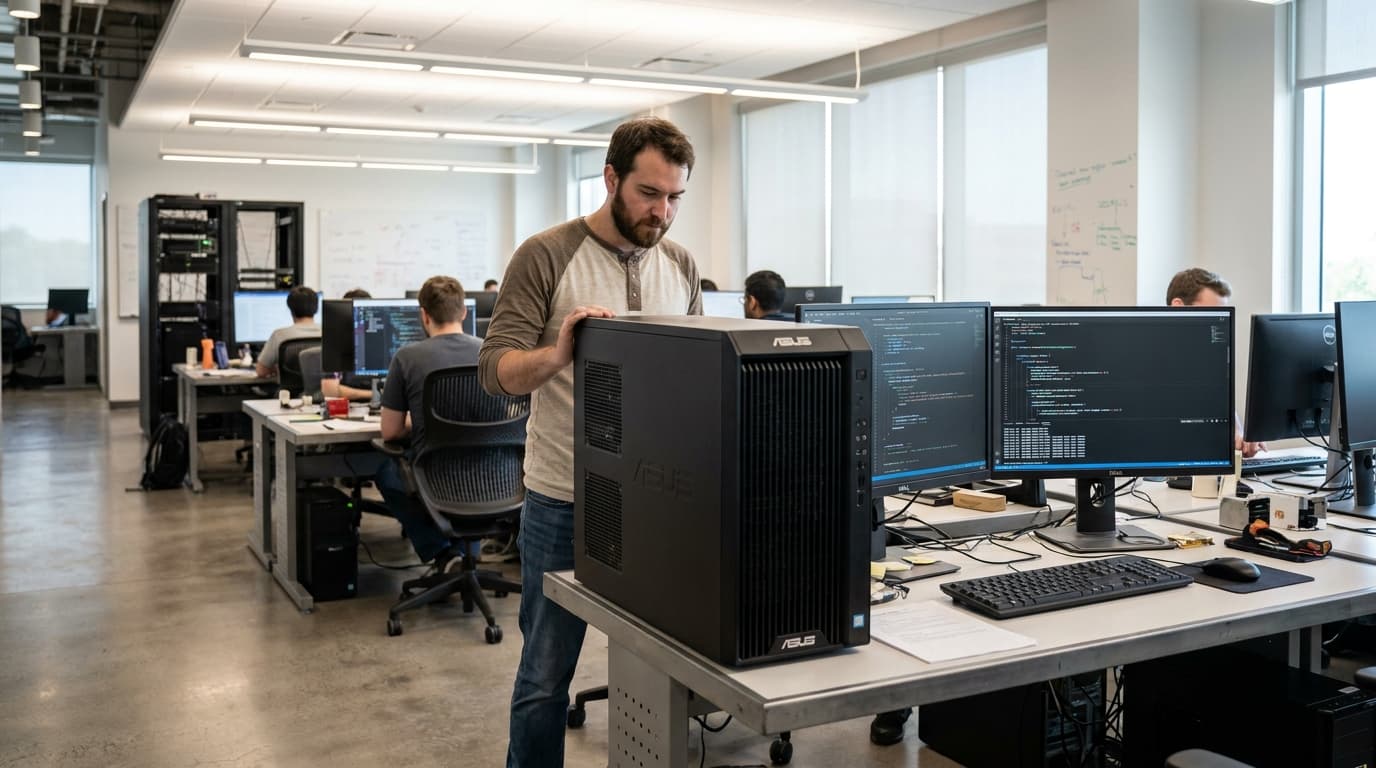
TL;DR: Asus released a new workstation powered by Nvidia's GB300 Grace Blackwell superchip. The $120,000 machine offers 748GB of unified memory, bringing on-premise AI supercomputing power to a desktop form factor for elite development teams.
Key facts
- Category
- AI
- Impact
- High
- Published
- Source
- TechRadar
Full summary
Asus and Nvidia have packed a $120,000 AI supercomputer into a desktop workstation, featuring 748GB of unified memory for developers.
Asus has officially launched a new class of AI workstation that packs the power of a data center into a desktop tower. According to a report from TechRadar, the ExpertCenter Pro ET900N G3 is a 27-kilogram machine powered by Nvidia's new GB300 Grace Blackwell superchip. This system is designed for elite AI development teams, combining 72 ARM-based CPU cores with a next-generation Blackwell architecture GPU. One reviewer cited by the report called the estimated $120,000 system "the most capable thing we’ve ever put on a desk." The workstation’s defining feature is its massive 748GB pool of high-speed, coherent memory, which fundamentally changes how large AI models can be developed and run outside of a traditional cloud environment. This release signals a significant shift, making on-premise AI supercomputing a more accessible option for organizations that can afford the substantial initial investment.
The core innovation of the GB300 superchip is its unified memory architecture. In conventional high-performance computing systems, the CPU has its own system memory (RAM), and the GPU has its own dedicated video memory (VRAM). A major bottleneck in AI training and inference is the constant need to copy massive datasets back and forth between these two separate memory pools over a relatively slow connection. The Grace Blackwell platform eliminates this problem by creating a single, coherent 748GB memory space that both the CPU and GPU can access directly at very high speeds. This allows developers to work with enormous models and datasets that would otherwise be too large to fit in a GPU's VRAM, without the performance penalty of data shuffling. This unified approach simplifies programming, reduces latency, and unlocks performance previously only achievable in multi-node server clusters, effectively bringing true supercomputer architecture to a single workstation.
This new workstation from Asus is part of a broader industry trend toward decentralizing AI compute power. For years, training and running state-of-the-art AI models has been the exclusive domain of hyperscale cloud providers and a few large enterprises with the resources to build their own data centers. The GB300 platform represents a strategic move by Nvidia to package and sell data-center-level performance directly to enterprise customers for on-premise use. This challenges the cloud-first model by offering an alternative that provides greater data privacy, security, and control over intellectual property. For companies working with highly sensitive data or requiring real-time inference with minimal latency, moving AI workloads in-house is becoming an increasingly attractive proposition. The ExpertCenter Pro is an early example of the hardware enabling this shift, putting immense power directly into the hands of development teams.
For CTOs and engineering leaders, the arrival of systems like the Asus ExpertCenter Pro presents a new strategic choice for AI infrastructure. The six-figure price tag requires careful financial analysis, weighing the upfront capital expenditure against the recurring operational costs of renting equivalent GPU instances from cloud providers like AWS, Google Cloud, or Azure. For teams with sustained, high-intensity AI workloads, the total cost of ownership for an on-premise system could be lower over a multi-year horizon. The key factors to watch next will be the adoption rate of these new workstations and the expansion of the software ecosystem, including Nvidia's CUDA platform, to fully exploit the coherent memory architecture. As other hardware manufacturers like Dell and HP inevitably release their own GB300-based systems, increased competition may also influence pricing and feature sets, further accelerating the move toward powerful, localized AI development.
Why it matters
This workstation makes large-scale AI model training and inference accessible outside of massive data centers. For AI developers and CTOs, the 748GB of coherent memory simplifies development by eliminating the need to manually shuffle data between CPU and GPU memory, accelerating complex workflows and enabling larger models on-premise.
Business impact
The $120,000 price tag positions this as a strategic capital investment for companies serious about in-house AI development. It offers a potential long-term cost advantage over cloud GPU rentals for sustained workloads and gives companies greater control over their sensitive data and AI intellectual property.
Tags
Related on Notifire
Related stories
Primary source: TechRadar