Tesla's AI Can Speed, But You Pay the Fine
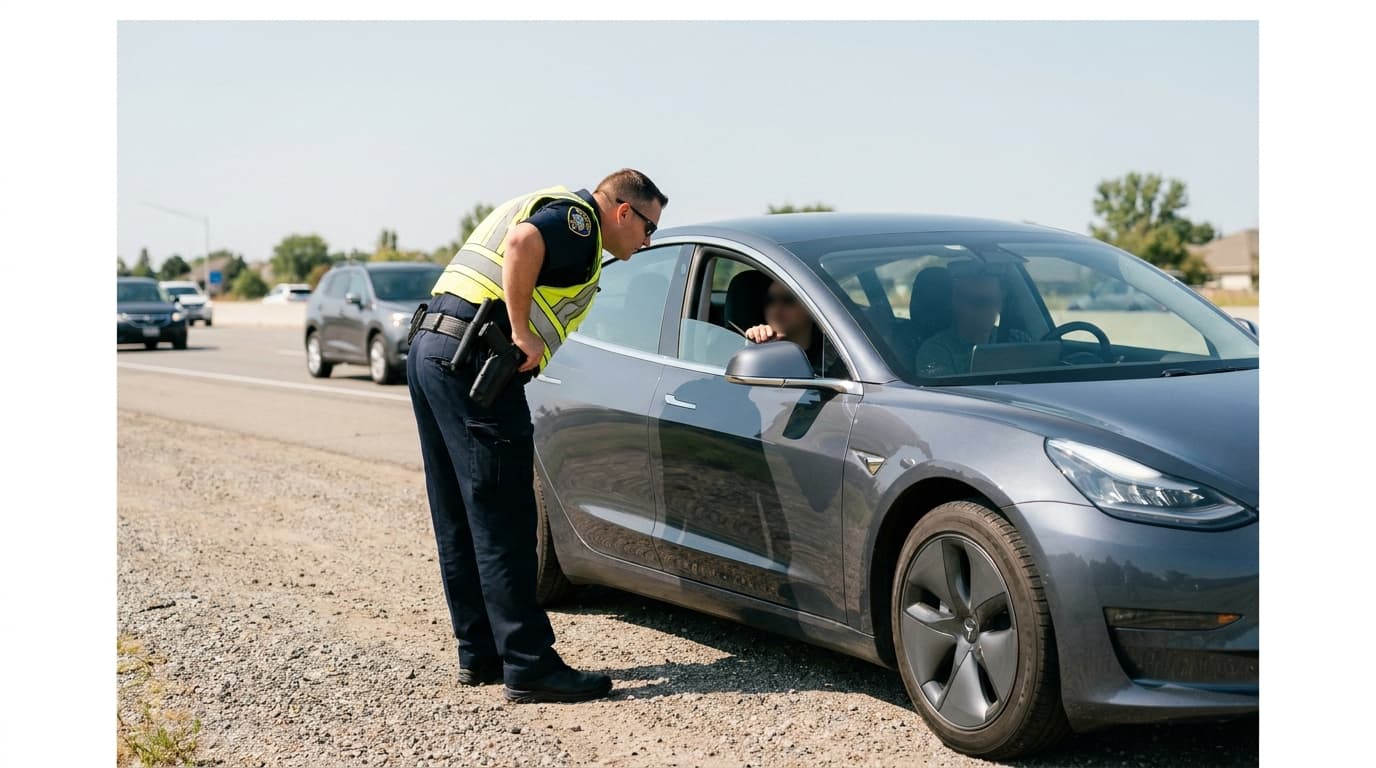
TL;DR: A Tesla driver using Full Self-Driving was ticketed for speeding after blaming the car's AI. The incident highlights a critical gap: the law holds the human operator fully responsible, regardless of the technology's sophistication.
Key facts
- Category
- Tech Updates
- Impact
- High
- Published
- Source
- TechRadar
Full summary
A Tesla driver blamed the car's AI for a speeding ticket, highlighting the growing legal gap between autonomous systems and driver liability.
A recent traffic stop in Parker, Colorado, has become a focal point for the debate on AI and accountability. According to a report from TechRadar, police pulled over a Tesla for traveling 64 mph in a 45 mph zone. When confronted, the driver attempted to deflect blame by stating that the car’s Full Self-Driving (FSD) system was active at the time. The officer's response was unequivocal: a speeding ticket was issued to the driver, not the software. This incident, captured on video, serves as a stark and practical illustration of a complex issue. It demonstrates that in the eyes of current law enforcement and legal frameworks, the ultimate responsibility for a vehicle's actions rests squarely on the shoulders of the human in the driver's seat, regardless of how much control they have ceded to an automated system.
This legal stance is rooted in the technical reality of today's driver-assistance systems. Despite its name, Tesla's Full Self-Driving is not a fully autonomous system. It is classified as a Level 2 driver-assistance system by the Society of Automotive Engineers (SAE). This classification means the vehicle can control steering, acceleration, and braking under certain conditions, but it requires the driver to remain fully engaged, monitor the environment, and be prepared to take immediate control at all times. True autonomy, where a driver is not required (Level 4 or 5), is not yet commercially available to the public. The system's reliance on a human supervisor is a fundamental design principle, meaning the driver's claim that they “weren’t driving” is legally and technically inaccurate. The system is designed to assist, not replace, the operator.
For developers, CTOs, and founders, this incident is a critical case study on the profound gap between user perception and technological reality. The marketing and branding of features like “Autopilot” and “Full Self-Driving” can inadvertently lead users to over-trust the technology and misunderstand their role as the responsible operator. When users believe a system is more capable than it is, they are more likely to use it improperly, leading to dangerous situations and legal trouble. This highlights a crucial responsibility for tech companies: to communicate the limitations of their AI systems as clearly and forcefully as they market their capabilities. Failure to manage user expectations can create significant liability risks, not just for the user but potentially for the company, and can erode public trust in emerging technologies.
The business implications extend far beyond Tesla, impacting the entire autonomous vehicle and AI industries. Every incident where AI is blamed for a human's legal infraction fuels public skepticism and invites greater regulatory scrutiny. For companies building any kind of AI-powered product that operates in the physical world or makes critical decisions, this serves as a powerful reminder. The legal and ethical frameworks that govern liability are evolving much more slowly than the technology itself. Therefore, a core part of product strategy must involve designing for accountability. This means building robust monitoring systems to ensure proper use, creating clear user interfaces that reinforce the operator's responsibility, and crafting marketing language that is precise and avoids creating a false sense of security.
Looking ahead, the legal landscape will be shaped by cases like this. As more AI-assisted vehicles take to the roads, we can expect a rise in legal challenges that test the boundaries of liability. These early court cases will set crucial precedents, forcing lawmakers and regulators to create new rules for the age of automation. For the tech industry, the key is to be proactive. Companies should anticipate these legal challenges by investing in transparent system design, comprehensive driver education, and clear documentation of a system's capabilities and limitations. The central takeaway remains unchanged for the foreseeable future: if you are in the driver's seat, you are in control, and you are responsible for the outcome.
Why it matters
This incident is a critical case study for tech leaders on the gap between AI capabilities, user expectations, and the law. It proves that despite advanced automation, the human operator remains legally and financially responsible for the system's actions.
Business impact
For companies developing AI systems, this highlights the risk of overstating capabilities. Misaligned user perception can lead to misuse, legal challenges, and regulatory scrutiny, reinforcing the need for clear communication about system limitations and user responsibility.
Tags
Related on Notifire
Related stories
Primary source: TechRadar