Tesla's Self-Driving Demo for Regulators Breaks Rules
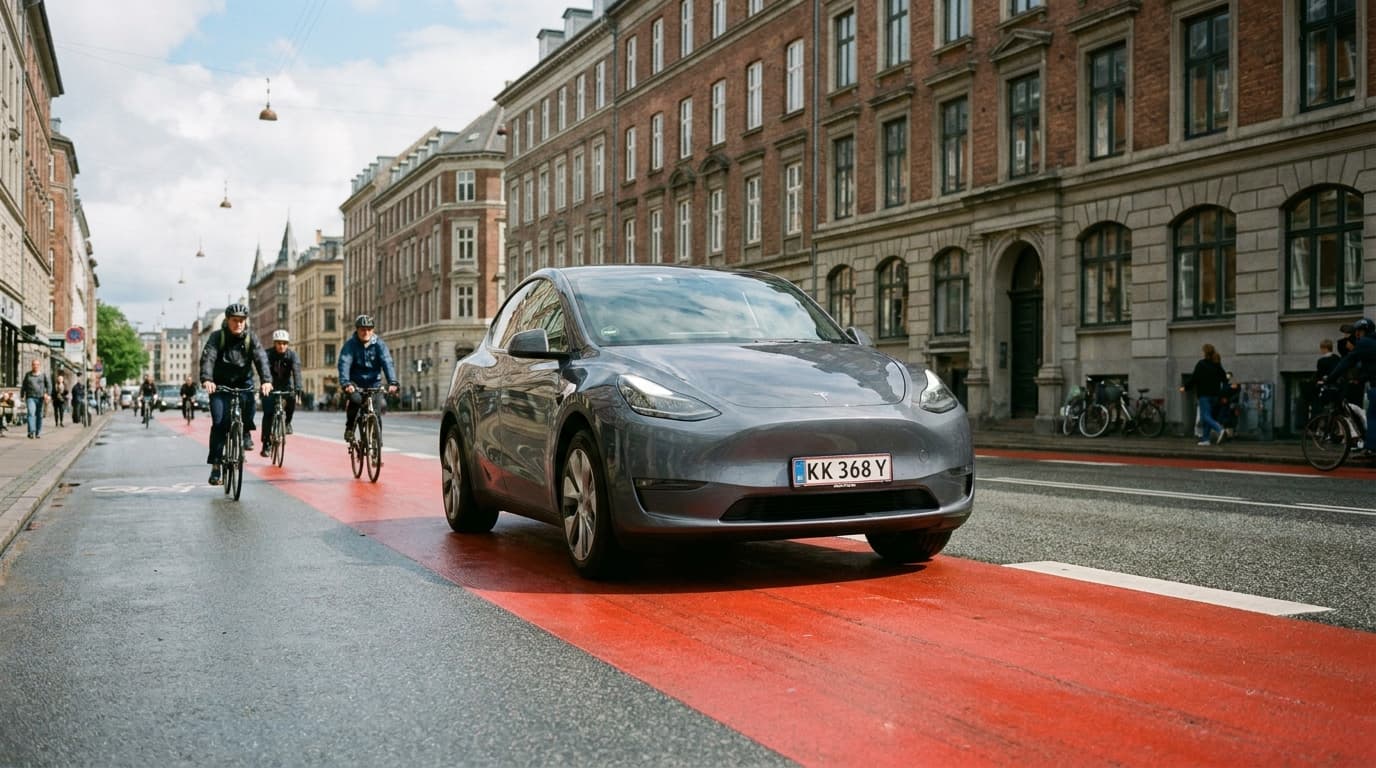
TL;DR: In a video submitted for regulatory approval in Denmark, Tesla's Full Self-Driving system is shown illegally using a bicycle lane. The failure highlights the major challenges autonomous systems face in adapting to complex, real-world international driving environments.
Key facts
- Category
- Tech Updates
- Impact
- High
- Published
- Source
- Hacker News
Full summary
A Tesla video for Danish regulators shows its Full Self-Driving system illegally using a bicycle lane, revealing significant real-world performance gaps.
Tesla submitted a video to the Danish Road Directorate as part of its application to get its Full Self-Driving (FSD) feature approved in Denmark. The video, meant to demonstrate the system's competence, instead captured it making several significant errors on the streets of Copenhagen. Within the first 12 seconds, the vehicle is shown illegally entering and driving in a dedicated bicycle lane to navigate around another car. This wasn't an isolated incident; reports indicate the system committed other mistakes throughout the recorded drive. The fact that these failures occurred in footage hand-picked by Tesla for a regulatory submission makes the event particularly revealing. It suggests a potential disconnect between the company's internal evaluation of the system's capabilities and its actual performance in a new, complex urban environment.
For founders, CTOs, and developers in AI and robotics, this incident serves as a powerful cautionary tale. It highlights the immense difficulty of scaling autonomous systems from one region to another, where subtle differences in road infrastructure, signage, and local driving customs can lead to critical failures. The problem of "edge cases" is not just about rare, unpredictable events but also about common, localized norms that a system hasn't been trained on. This case demonstrates the significant gap that can exist between a product's performance in its primary development market, like the United States, and its reliability in international contexts. It underscores the high stakes of deploying AI in safety-critical applications without exhaustive, region-specific testing and validation.
The failure in the approval video also raises important questions about product marketing versus engineering reality. Deploying systems under a "beta" label while making bold claims about their capabilities creates regulatory and public trust challenges. For technical leaders, this situation reinforces the need for transparent communication about a system's current limitations. The path forward for autonomous technology depends on solving these localization challenges. It requires moving beyond simply training models on more data to developing systems that can adapt to novel situations and interpret local context correctly. Until then, deploying such systems requires careful oversight and a realistic understanding of their current state, not just their future potential.
Why it matters
This incident is a stark, real-world example of the 'localization' problem in AI. It shows how even advanced systems can fail when deployed in new environments with different rules and infrastructure, highlighting the gap between controlled testing and real-world performance.
Business impact
The failure in an official regulatory submission creates significant reputational damage and potential delays in market access for Tesla. It serves as a warning for all tech companies about the risks of overstating product capabilities, especially in safety-critical, regulated industries.
Tags
Related on Notifire
Related stories
Primary source: Hacker News