Kioxia Is Turning SSDs Into Cheaper Server Memory
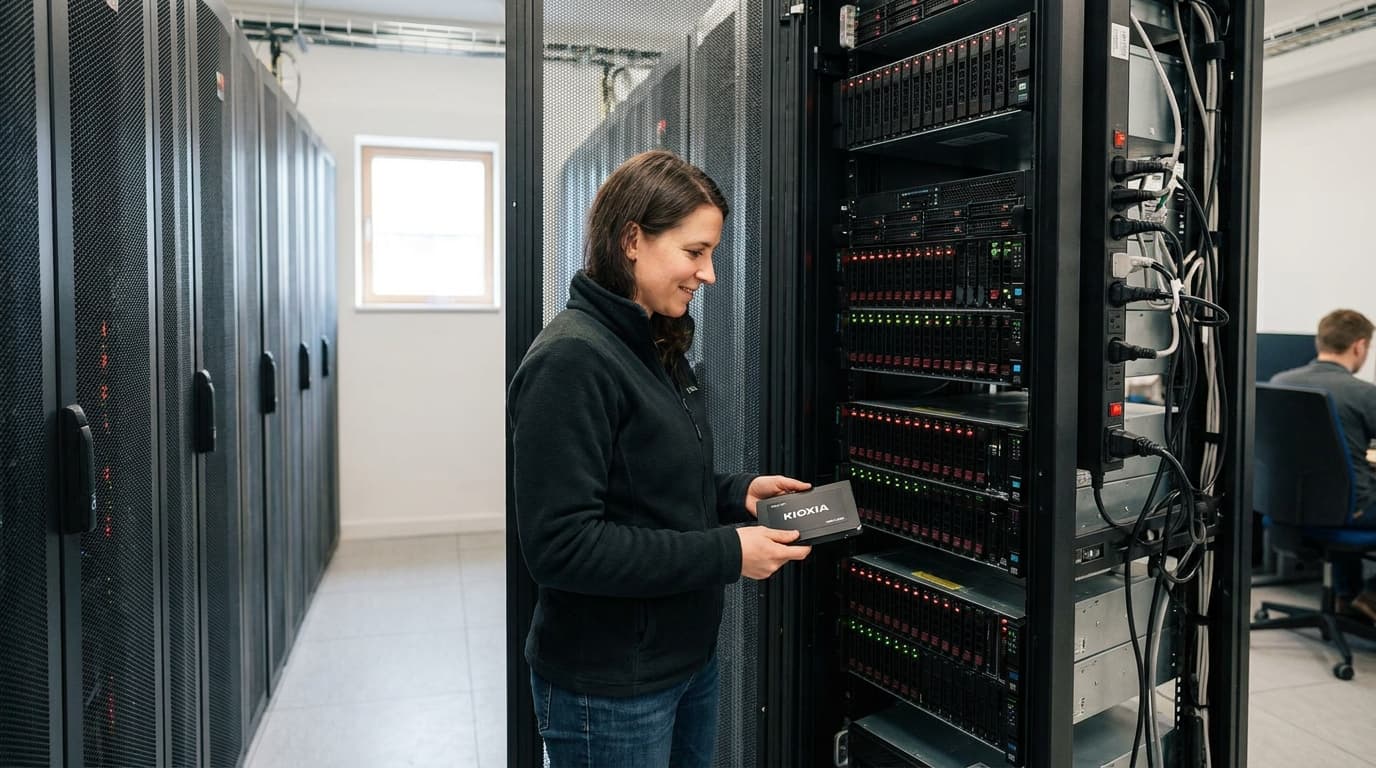
TL;DR: Kioxia is developing new flash memory products that act like traditional RAM. This could help data centers dramatically expand memory capacity for AI workloads without the high cost of DRAM, easing a major infrastructure bottleneck.
Key facts
- Category
- Infrastructure
- Impact
- High
- Published
- Source
- TechRadar
Full summary
Kioxia is developing flash memory to help data centers reduce their dependence on costly DRAM for demanding AI workloads.
Memory manufacturer Kioxia is developing a new class of flash storage products designed to tackle the growing memory crisis in artificial intelligence, according to a report from TechRadar. The massive growth of AI models has created an insatiable demand for system memory, pushing the cost and capacity limits of traditional Dynamic Random-Access Memory (DRAM). As data centers struggle to keep up, the high price and physical constraints of DRAM have become a significant bottleneck for scaling AI workloads. Kioxia’s strategy aims to sidestep this problem by using its expertise in flash memory, the same technology found in Solid-State Drives (SSDs), to create a new tier of memory that is cheaper and more scalable than DRAM. This approach could allow data centers to add terabytes of memory capacity for AI training and inference tasks at a fraction of the cost of relying on DRAM alone, fundamentally changing the economics of building AI infrastructure.
The core technology enabling this shift is Compute Express Link, or CXL. CXL is an open industry standard that creates a high-speed, low-latency connection between a central processor and other devices like GPUs, accelerators, and now, storage. Traditionally, a server’s CPU could only access DRAM as its main memory, while SSDs were treated as much slower block storage, accessed through a different, less efficient pathway. CXL changes this by allowing a specially designed SSD to connect directly to the CPU’s memory controller. This makes the flash storage appear to the system as an extension of its main memory pool. Known as a "memory-semantic SSD," this device can be accessed with much lower latency than a standard drive, bridging the performance gap between DRAM and storage. Kioxia’s planned products are expected to leverage the upcoming PCIe 6.0 interface, which will provide the necessary bandwidth to make this memory expansion practical for demanding applications.
Kioxia is not alone in pursuing this new memory architecture. The move is part of a broader industry trend toward disaggregated and composable systems, driven by the unique demands of modern computing. Major memory players like Samsung and Micron are also heavily invested in developing their own CXL-based solutions, including memory expansion modules and software to manage these new heterogeneous memory environments. For years, the server industry has been constrained by a rigid architecture where compute, memory, and storage are tightly coupled within a single box. The rise of large-scale AI and data analytics has exposed the inefficiency of this model. CXL represents a critical step toward breaking down these silos, enabling system designers to create flexible pools of resources that can be allocated on demand. This allows for more efficient hardware utilization and makes it possible to build systems with memory capacities that were previously unimaginable or cost-prohibitive.
For CTOs, developers, and infrastructure teams, Kioxia’s development is a clear signal of where the industry is headed. While these products are not yet on the market, the underlying CXL technology is already appearing in the latest generation of servers from major manufacturers. This means that teams planning hardware refreshes should begin evaluating platforms with robust CXL support to future-proof their investments. The key consideration will be understanding the performance trade-offs. While CXL-based flash memory offers immense capacity at a lower cost, it will not match the near-instantaneous response times of DRAM. Workloads will need to be profiled to determine which data can reside in the slower, larger flash tier without impacting overall performance. The next steps will be to watch for official product announcements, independent performance benchmarks, and adoption by major cloud providers. The success of this technology will ultimately depend on its ability to deliver a compelling balance of cost, capacity, and real-world speed for AI applications.
Why it matters
For infrastructure teams and AI developers, this signals a major shift in memory architecture. Using CXL to pool flash storage as memory could solve the capacity and cost crisis of DRAM, enabling larger AI models and more efficient data center scaling.
Business impact
This development could significantly lower the total cost of ownership for AI infrastructure, a major capital expense. By providing a cheaper alternative to massive DRAM installations, Kioxia's technology could make large-scale AI more accessible and shift market dynamics.
Tags
Related on Notifire
Primary source: TechRadar